
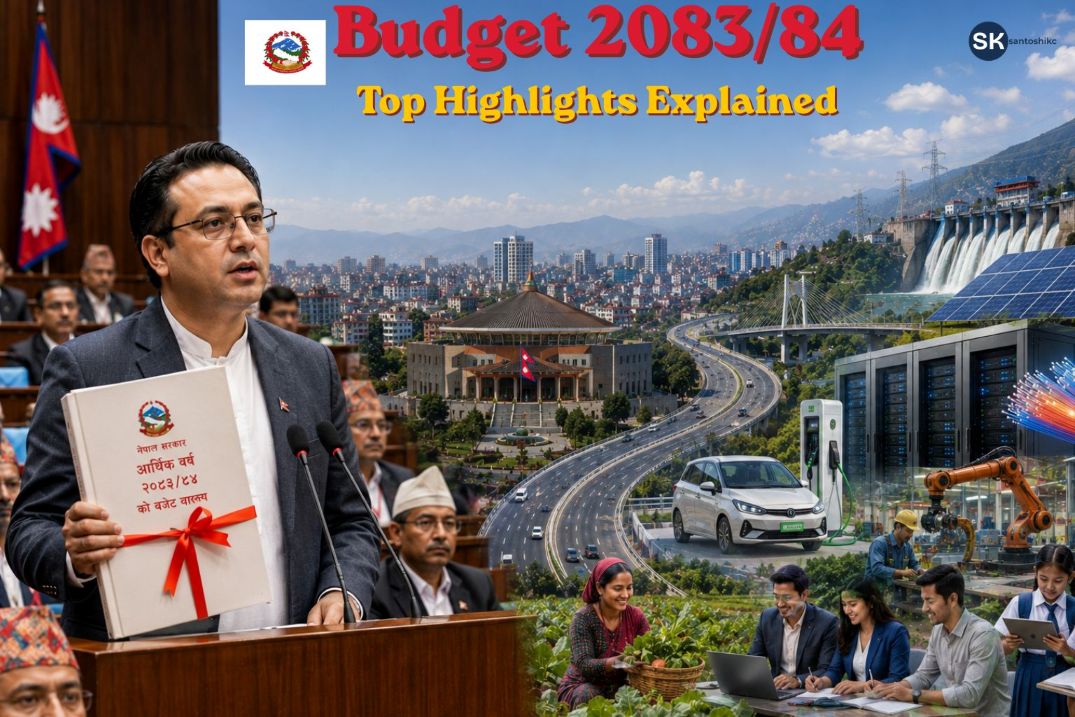
Fiscal Year 2083/84 Nepal Budget: No Tax Up to 10 Lakhs! Highlights & Key Changes
The official announcement of the Fiscal Year 2083/84 Nepal Budget (2026/27) has brought massive economic structural changes across the nation. Presented by Finance Minister Dr. Swarnim Wagle in the Federal Parliament, the total Fiscal Year 2083/84 Nepal Budget layout stands at a historic NPR 2,124.34 Billion (21 Kharba 24 Arba 34 Crore).
Rather than focusing entirely on heavy macro-regulation, this strategic fiscal roadmap addresses middle-class financial relief, public workforce stabilization, and high-yield incentives for tech exporters and commercial agriculture. Let us break down the eight most significant policy shifts and how they directly alter your personal and professional finances.
1. Zero Income Tax Up to 10 Lakhs: Fiscal Year 2083/84 Nepal Budget Threshold
- Earn up to 10 Lakhs a year? Take a deep breath—your basic income tax rate is now officially 0%! In an aggressive move to counter market inflation and reverse skilled brain drain, the government has doubled the previous tax-exempt baseline from 5 Lakhs up to NPR 1 Million (10 Lakhs) per annum for individual earners under this new Fiscal Year 2083/84 Nepal Budget framework.
- To incentivize medical professionals, engineers, and corporate headers to stay in Nepal, the highest individual marginal income tax tier has been reduced by 10 percentage points, dropping from 39% down to 29%.
2. The 10% Instant Digital VAT Cashback Loop
- Stop carrying cash! Scan your favorite mobile banking app or digital wallet and watch your VAT bill drop instantly at checkout. To disincentivize parallel informal markets and encourage digital financial tracking, a real-time point-of-sale fiscal rebate has been introduced.
- Consumers processing retail transactions or dining bills via licensed payment service providers (like eSewa, Khalti, or mobile banking apps) will receive an automated, immediate 10% refund on Value Added Tax (VAT) printed directly on their invoice.
3. Civil Service Salary Adjustments: A Net 21% Pay Raise
- The painful 4-year salary freeze is broken. Civil servants, government teachers, and security forces are getting a major monthly income upgrade. Following years of compounding market inflation, public sector salaries have been adjusted using a distinct dual-component formula:
- A 10% flat increment on the basic, baseline salary scale.
- A 10% monthly performance incentive allowance, structurally tying the total payout to real organizational output.
- Effective July 17, 2026 (Shrawan 1, 2083), entry-level public sector wages will start around NPR 40,000, while senior leadership roles will scale beyond NPR 100,000 per month. If you are preparing for these highly competitive public exams, make sure to read our comprehensive guide on Loksewa preparation tips to crack the upcoming vacancy sessions.
4. Legitimizing the Tech Export Corridor & Freelancer Ecosystem
- Build global software products from your bedroom in Kathmandu—100% legally, with zero tax on your sweat equity! Positioning the nation as a regional technology node, IT exporters will enjoy a 50% corporate income tax holiday. Furthermore, any compensation issued via sweat equity is now 100% tax-free.
- The state has finalized funding to build Nepal’s inaugural Sovereign AI Compute Center in Syuchatar, Kathmandu. The facility will house high-powered graphics processing units (GPUs) to let local tech startups rent raw computing infrastructure at subsidized, low-cost rates. This massive state support aligns perfectly with the compounding AI benefits in modern industries, paving the way for next-generation automation in Nepal.
- Foreign exchange and cross-border banking guidelines are being simplified to allow friction-free routing of inward foreign currency remittances and international software service licensing fees. You can safely manage your cross-border remote work using these new official banking corridors.
5. Free Childhood Cancer Treatment & Universal Health Targets
- No family will ever be forced into bankruptcy or deep poverty to save their child—pediatric oncology treatment is now fully cost-free. Under the newly structured health budget, all childhood cancer treatments at government-run hospitals nationwide will be 100% free of charge.
- To shield middle-class families from sudden, catastrophic health costs, NPR 15 Billion has been injected into the National Health Insurance Program, setting a strict target to bring 90% of the population under universal coverage within 36 months.
6. The “Blue Bus” Fleet and Clean Energy Grid Expansion
- Urban mass transit is getting a modern upgrade—introducing CCTV-secured, dedicated safe buses for women. Kathmandu Valley and Pokhara will pilot the “Blue Bus” initiative, a public transit framework specifically deployed to offer comfortable, secure travel alternatives for women, backed by live security camera networks.
- The national grid is scheduled to absorb an additional 1,040 Megawatts (MW) of clean energy (670 MW from upcoming hydropower plants and 370 MW from solar fields). Additionally, the landmark 1,028-km East-West Highway has received a capital injection to accelerate its phased expansion into a 4-lane expressway.
7. A Corporate Remake for Agriculture: 40% Cash-Back Grants
- Invest 2 Crore in modern commercial farming, and the government will deposit 80 Lakhs straight back into your business bank account. Traditional subsistence farming is receiving a structural corporate upgrade. Aggressive entrepreneurs who invest a minimum of NPR 20 Million (2 Crore) into scaled commercial agriculture qualify for a 40% capital reimbursement grant, paid back directly at 10% annually over four years of successful production.
- To permanently address chronic seasonal shortages, NPR 32.46 Billion is locked into a legally mandated “Supply Calendar”, forcing chemical fertilizer logistics to finish regional distribution before peak seed cultivation starts.
8. Deep Fiscal Consolidation: Shutting Down 31 Agencies
- To pay for citizen tax cuts, the government has used a strict fiscal razor to eliminate its own structural waste. The state has finalized the complete dissolution and closure of 31 overlapping government boards, departments, and agencies, yielding an estimated NPR 20 Billion in recurrent cost savings.
- Public entities are now prohibited from acquiring luxury office vehicles, high-end electronics, or utilizing premium private resorts for routine internal training seminars and administrative workshops.
Macro Analysis: Key Insights of Fiscal Year 2083/84 Nepal Budget
To maintain strict macroeconomic transparency, the national balance sheet relies heavily on optimizing domestic tax collection while bridging the remaining deficit via external borrowing windows.
Where the Money Goes (Expenditure Distribution)
| Expenditure Class | Simple Functional Purpose | Budget Allocation (NPR) | Percentage Share |
|---|---|---|---|
| Recurrent Spending | Public salaries, administrative operations, and civil welfare. | 1,270.58 Billion | 59.8% |
| Capital Infrastructure | Building expressways, bridge networks, and green power grids. | 431.10 Billion | 20.3% |
| Financial Management | Servicing principal and interest bounds on existing public debt. | 422.64 Billion | 19.9% |
| Total Outlay | Combined Federal Fiscal Spending Blueprint | 2,124.34 Billion | 100% |
Where the Money Comes From (Financing Strategy)
- Internal Tax and Revenues: Projected to collect NPR 1,405.31 Billion via direct internal revenue collection and customs.
- Bilateral Foreign Grants: Confirmed international donor aid totals NPR 61.74 Billion.
- Fiscal Deficit Funding: The remainder shortfall of NPR 657.29 Billion will be managed by balancing NPR 247.28 Billion in foreign soft loans and generating NPR 410 Billion through domestic bank borrowing and government bonds.
Verdict: Progressive Intent Facing an Execution Trial
The macro target of the Fiscal Year 2083/84 Nepal Budget aiming for an ambitious 7% GDP growth rate while attempting to lock consumer inflation below 6% marks a definitive departure from traditional economic frameworks. It offers structural tax breaks to the middle class and opens clear regulatory paths for digital service exports. With shifting tax brackets and new public perks, many professionals are now re-evaluating the career debate between private vs government jobs in Nepal to secure their financial future.
However, the historical bottleneck in Nepal’s public financial management has never been the design of the fiscal speech—it is the capital expenditure implementation velocity. Whether the 31 redundant offices are liquidated smoothly and the 1,040 MW of power safely meets the grid without bureaucratic corruption will ultimately decide if this new fiscal framework acts as an economic launchpad or remains a collection of well-crafted promises.
(Official Data Source: Ministry of Finance, Government of Nepal)_