Buying Land in Nepal? 5 Costly Lalpurja Mistakes Under the New Land Administration Directive 2081
The Paper That Feels Safe But Isn’t
Think about this for a second.
You save money for years. Maybe your whole life. Then one day, you buy a piece of land. You get a Lalpurja, the official Land Ownership Certificate, and you hold it in your hands.
It feels like proof. It feels like safety. Like nothing can go wrong now.
But here is the hard truth. A Lalpurja only proves that a transaction happened. It does not prove that the transaction was safe.
That one gap, between “a paper was signed” and “the land is actually yours to use,” is where families lose their life savings. Not once in a while. Again and again, across Nepal.
If you are just starting the land buying process in Nepal, this gap is exactly what you need to understand first, before you look at a single plot.
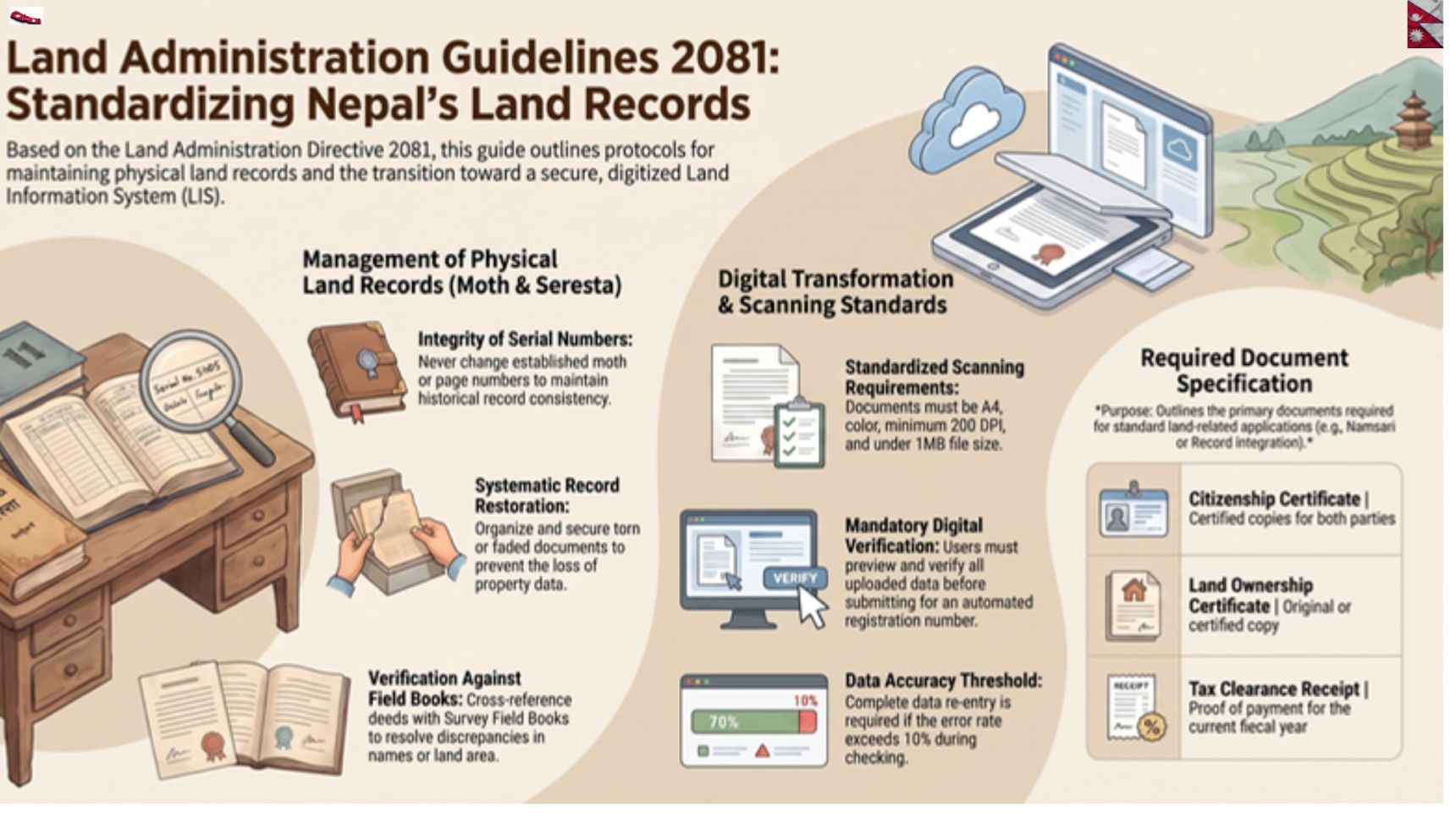
This is why the government brought in a new rule called the Land Administration Directive 2081. It is not a small update. It changes how land records are kept, checked, and trusted, from top to bottom.
If you are buying land the old way, based only on trust and a certificate that looks clean, you are taking a risk you don’t need to take.
This guide is simple on purpose. Five mistakes. What the law actually says. And what you should do about it, in plain words anyone can follow.
Understanding the Land Buying Process in Nepal: From Old Paper Books to a New Digital System
For a very long time, the real record of who owns what land lived inside a huge, hand-bound book called the Moth. This sat inside something called the Sresta, the official land record, at the local Malpot (Land Revenue) office.
Whoever controlled that paper book controlled the truth about your land.
Now, under Directive 2081, this is moving onto a computer system called NeLIS, short for Nepal Land Information System. In simple words, this means your land’s status can be checked online, and it becomes much harder to quietly change or hide something.
But here is the part that matters most right now. We are in a transition period. Some offices have already moved everything onto the computer. Others are still working on it.
If the computer record says one thing, and the old paper book says something else, you are standing in a confusing middle zone. And confusing zones are exactly where fraud likes to hide.
The law has a fix for this. Under Parichhed 2, Section 27 of the Directive, the office is required to do something called Moth Bhidane. This simply means checking the paper book against the computer record, line by line, to make sure nothing was missed. Never assume the computer screen is telling you the whole story until this checking has actually been done.
Mistake 1: Buying Land Without Checking What It’s Legally Allowed to Be Used For
What usually goes wrong. Someone falls in love with a plot. It looks beautiful. They pay the advance. Later, they go to build a house, and the local ward office says no. Why? Because the land is officially registered as agricultural land, not residential. The plot-cutting done to sell it, called Kitakat, was never properly approved.
What the law says. Under the Land Use Act 2076/2079 and Directive 2081, every single piece of land in Nepal has an official classification, called Bhu-Upayog. Section 342 puts strict limits on cutting up agricultural land to sell as small residential plots.
What you should do. Before you agree to anything, ask to see the Napi Sherya Kitab, also known as the Survey Field Book. This one document tells you the real, legal classification of the land, and whether it was ever properly approved for building. Middlemen, called Bichauliyas, will almost never bring this up on their own. You have to ask for it, clearly and directly.
Mistake 2: Trusting a Certificate Just Because It Looks Clean
What usually goes wrong. The seller shows you a Lalpurja. No strange stamps. No marks on the back. It looks perfect. You pay the advance feeling relieved. Then, at the Malpot office, the deal gets stopped, because the computer system shows something called a Rokka, a legal freeze placed by a court or a bank.
What the law says. Parichhed 6, Sections 180 to 182 of the Directive make this very clear. The digital record inside NeLIS is the real truth, even if it disagrees with the paper certificate. A freeze can be placed on a computer within seconds, long before anyone writes it down on the old paper book.
What you should do. A perfectly clean-looking certificate is often exactly what a dishonest seller wants you to see. It is not rare for one plot of land to be sold to several buyers at once, with each of them told it’s completely free and clear. Go to the Malpot office yourself. Confirm the land shows as Fukuwa, meaning fully released, with no freeze, inside NeLIS. Do this before you pay anything, not after.
Mistake 3: Forgetting That Land Often Belongs to a Whole Family, Not Just One Person
What usually goes wrong. You buy land from a father. He seems to be the only owner. A month later, his wife or his sons show up with a lawsuit, saying their share of the family inheritance, called Amsa, was never included in the sale. Your new land gets frozen. You might spend years in court over land you already paid for in full.
What the law says. The Muluki Civil Code 2074, along with Section 147 of Directive 2081, is strict about this. If land is part of a joint family holding, called Sagol, it cannot be sold unless every legal heir, called an Amsiyar, signs a written consent letter, known as a Manjurinama.
What you should do. Ask for the seller’s Tin-Pustey, meaning their three-generation family history. Compare it carefully against the consent papers. Section 151 says every heir named in that history must be accounted for. If someone is missing, especially a family member living abroad without proper power of attorney, called Warris, do not treat it as a small detail. Pause the deal until it is fully sorted out.
Mistake 4: Skipping the Physical Visit to the Actual Land
What usually goes wrong. Your Lalpurja says you own 10 Aana of land. Later, when you try to build a wall, you learn that road or river setback rules take away part of your plot. Suddenly you only have 7 Aana of usable land. You paid full price for land that, in real life, was never fully yours to use.
What the law says. Parichhed 16 of the Directive protects public land, like roads and riverbanks. A common cause of this problem is missing something called Lagat Katta. This happens when the government takes a strip of land for a road, but the Malpot record is never properly updated, as described in Section 276. The land stays listed on your certificate on paper, but on the ground, it already belongs to the state.
What you should do. Never skip a physical Sandh-Sarpanna, a boundary verification done on-site by a certified surveyor. Compare the surveyed land size with the official Trace Map. Make sure any road or river setback has already been subtracted before you agree on a final price.
Mistake 5: Letting Someone Else Handle Your Digital Paperwork
What usually goes wrong. You hire a Bichauliya, a middleman, to make the process faster. To save you a trip, they log in using their own account to handle your transaction. From that point forward, the digital trail belongs to them, not to you.
What the law says. Parichhed 21 of the Directive clearly defines different types of digital users, including a one-time login category called Patake Prayogkarta, under Section 390. The whole system is built around the idea that every transaction should be tied to your own verified identity, not someone else’s.
What you should do. If anything goes wrong with an entry made under another person’s login, it is your name and your land that gets flagged, and fixing that can take months. Only work through certified Bhu-Sewa Kendras, official Land Service Centers, or the Malpot help desk directly. Always insist on receiving the OTP, the One Time Password, on your own phone number, as required under Section 27. That small code is not just a formality. It is the one thing standing between your land and a decision made without you.
A Simple Checklist You Can Save
Read this before you give any Baaina, meaning an advance payment. Go slowly. Do not skip a step just because the seller feels trustworthy or seems in a hurry.
- [ ] Check past ownership (Dakhil Kharej): Look at how the land changed owners in the past, to rule out old unresolved claims.
- [ ] Check freeze status (Rokka/Fukuwa): Confirm in NeLIS that the land has no court freeze or bank mortgage on it.
- [ ] Check family consent (Manjurinama): Make sure every heir named in the Tin-Pustey has given signed, valid consent.
- [ ] Check land classification (Bhu-Upayog): Confirm in the Napi Sherya Kitab that the land is legally allowed for residential use.
- [ ] Check the actual boundary (Sandh-Sarpanna): Match the real, on-ground size to the Trace Map, with setbacks already subtracted.
- [ ] Complete registration (Likhat Parit): Finish the transfer at the Malpot office with all seals and digital entries confirmed.
Frequently Asked Questions About the Land Buying Process in Nepal
What documents do I need before buying land in Nepal? At a minimum, you should review the seller’s Lalpurja, the Napi Sherya Kitab (Survey Field Book), the Tin-Pustey (three-generation family history), and the Dakhil Kharej history of past ownership transfers. Together, these tell you whether the land is legally clean, correctly classified, and free of family disputes.
How do I check if land is frozen (Rokka) in NeLIS? You can confirm a plot’s freeze status by visiting the Malpot office or an authorized Bhu-Sewa Kendra and asking them to check the land’s record inside NeLIS. A property with no active freeze will show as Fukuwa, meaning released.
What is the Land Administration Directive 2081? It is the updated set of rules that governs how land records are created, verified, and digitized in Nepal. It moves the country’s land administration system away from paper-only records inside the Moth and Sresta, toward a digital system called NeLIS.
Can I skip the physical site visit if the Lalpurja looks correct? No. The certificate shows the recorded size, but road and river setbacks, along with boundary disputes, only become clear through an on-site Sandh-Sarpanna, a physical boundary verification carried out by a certified surveyor.
Is it safe to let a middleman handle my land registration online? It is safer to complete your own digital verification using your own OTP and identity. Letting someone else use their login for your transaction means the digital trail, and any errors in it, gets tied to them instead of you.
A Simple Closing Thought
Directive 2081 was not written to make life harder for ordinary people. It exists because too many families, for too many years, lost everything over paperwork they never fully understood.
A smart buyer never stops at the Lalpurja alone. They check the Sresta. They read the Sherya Kitab. They make sure their own name, and no one else’s, is the one attached to their entry in the system.
Land in Nepal can be one of the safest gifts you ever give your family. Or it can quietly become one of the most painful mistakes of your life. The difference usually comes down to one thing: the questions you asked, and the papers you checked, before you paid a single rupee.
Take your time at the Malpot and Naapi offices. Save this checklist. Bring it with you when the day comes. Years from now, you and your family will be glad you did.
Whether you are buying your very first plot or your fifth, the land buying process in Nepal rewards patience far more than it rewards speed. A slower, well-checked purchase today is what protects your family’s future for decades to come.
This guide is based on the Bhu-Prashasan Nirdeshika 2081 and related Nepalese land laws. Land rules can be technical and vary case by case, so always confirm the specifics with your local Malpot office before finalizing any transaction.
Need information on other government services? Explore our Citizen Portal for step-by-step guides, official notices, and helpful resources.https://santoshikc.com.np/citizen-support-services-dashboard/