The Independent Desk and the Merit List: How I Cleared My Lok Sewa First Attempt with Zero Support
There is a particular kind of pressure that settles on you when you know you cannot afford to fail.
It is not just the financial strain that weighs you down, though counting every single rupee for room rent in a new city is hard enough. It is an emotional and social gravity pulling at you from every direction. One shot. No safety net. And a capital city that does not know your name yet.
This is not a motivational story dressed up in generic, copy-pasted advice. This is an unvarnished, investigative account of what actually happened in my small rented room—the hard daily choices, the strategic shifts in mindset, and the practical frameworks that allowed me to clear the Public Service Commission exam on my very first attempt.
Every year, thousands of candidates arrive in the capital, buying stack after stack of guidebooks and listening to endless lectures on how impossible the syllabus is. They are told that without an influential relative in the administration, an elite academic background, or permanent financial backing, the merit list is out of reach.
My experience proved otherwise. Succeeding on your first try is not about having perfect circumstances. It is about understanding what the exam actually demands from you and building a ruthless, quiet discipline inside the constraints of your real life.
Phase 1: The Anatomy of the Kathmandu Noise
My journey with work had started early; I began teaching in a school at the age of eighteen, stepping into the working world as a young girl to sustain myself while my college degree was running. The moment I finished my Bachelor’s degree in Pokhara, I made a definitive choice: I left that teaching job behind, packed my bags, and moved to Kathmandu alone. I plunged straight into serious, full-time preparation.
But moving to the capital to prepare for a competitive government exam means immediately running into an unexpected obstacle: an entire ecosystem of social commentary.
[THE SKENP-LOOP: KATHMANDU ANXIETY MATRIX]
Social Pressure (Marriage/Age) ──> Economic Strain (Rent/Survival) ──> Systemic Skepticism
                                      │
                                      ▼
                        [Result: Candidate Burnout]
The moment you clear your schedule to sit for the Lok Sewa exams, people around you suddenly develop opinions about your life choices:
- The Family Concern: Well-meaning anxiety from relatives that lands heavily like doubt.
- The Social Timeline: Unsolicited advice about whether a government job is “realistic” for a young woman, usually wrapped inside marriage pressures.
- The Systemic Cynicism: The quiet whispers that an outsider from a smaller city, operating without internal administrative connections, cannot break into the system on a first try.
The Turning Point: That noise is not information about your future. It is simply a reflection of other people’s fears and their own limited outlook.
People who are secure in their own journeys rarely waste time commenting on yours. The day I stopped treating their doubts as data about my capability, and started treating it like the unpredictable capital weather—something happening around me that I did not need to absorb—my studying became significantly more focused.
But tuning out the noise was only the mental setup. The real battle was managing the brutal isolation of the morning hours inside a rented room…
Phase 2: The Independent Candidate’s Micro-Routine for Lok Sewa Preparation
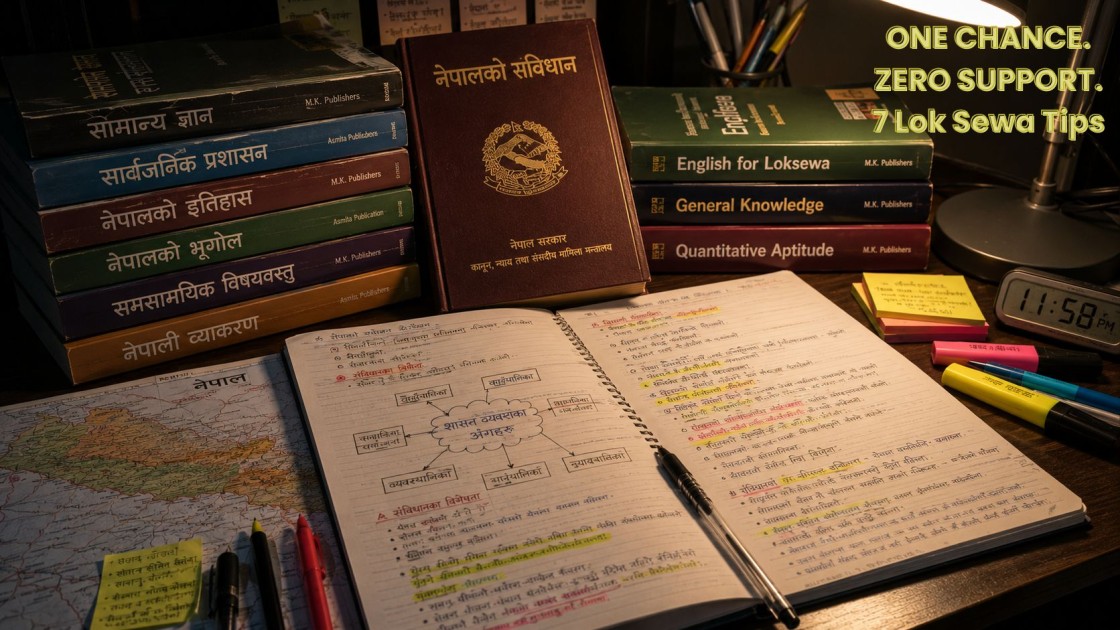
There is a widespread belief that the only way to pass Lok Sewa is to wait for the “perfect conditions”—the ideal study environment, the right group of senior candidates, or an expensive coaching institution layout. Because I had left my teaching income behind after graduation to bet everything on this single preparation phase in Kathmandu, I did not have the luxury of waiting.
My days were built on absolute structural efficiency. I did not have a study group, and I did not have a senior officer at home to guide my steps. My routine had to be built from scratch, entirely inside the walls of my room.
| Phase of the Day | Time Block | Specific Activity | Focus Metric |
|---|---|---|---|
| The Deep Window | 05:00 AM – 09:00 AM | Core Subjective Papers (Governance, Economy) | Conceptual clarity & structural writing |
| The Review Shift | 11:00 AM – 03:00 PM | Past Papers & Syllabus Mapping | Structural filtering over blind reading |
| The Data Tracking | 06:00 PM – 09:00 PM | Current Affairs, Constitution & GK Tables | Factual updates & precision recall |
Because I was working with limited time and resources before my financial runway ran out, I had to be ruthless:
- I forced myself into deep study during the cold mornings, even when the sheer scale of the syllabus felt overwhelming.
- I broke down topics into small, digestible units rather than reading massive volumes cover-to-cover.
- I practiced active mental recall, reviewing administrative frameworks silently in my head during basic daily chores.
What I discovered through this quiet routine is that a consistent, uninterrupted three-hour session every single morning compounds in ways that a chaotic, twelve-hour marathon session every few weeks never can. The human brain builds pattern recognition through constant, low-stakes exposure. When you build your routine tightly around the reality of your current environment, you develop a sharp, operational efficiency.
Yet, managing hours is useless if you waste them reading the wrong things. Here is how I hacked the massive syllabus using an investigative approach…
Phase 3: Decoding the Pattern (The Best Lok Sewa First Attempt Tips)
The Lok Sewa syllabus is notoriously broad, designed to cover an immense amount of ground from constitutional frameworks and administrative history to complex socio-economic indicators and global affairs. If you approach this vast terrain by trying to memorize every single fact with equal depth, you will completely exhaust your mental energy. You will arrive at the exam hall possessing a shallow understanding of everything and a structural command of nothing.
The turning point that transformed my preparation was when I set aside the standard guidebooks for a week, collected at least five years of previous question papers, and studied them systematically.
[THE STUDY STRATEGY SHIFT]

Traditional Path:  Read Syllabus Cover-to-Cover ──> Rote Memorization ──> Data Dumping (Low Marks)
Strategic Path:    Analyze Past 5 Years Papers ──> Map Core Frameworks ──> Structural Reasoning (High Marks)
The written papers of the Public Service Commission are not basic memory tests. They evaluate a specific style of analytical thinking. The examiners look for your ability to apply core concepts, reason clearly about Nepal’s administrative framework, and connect current socio-economic realities to governance.
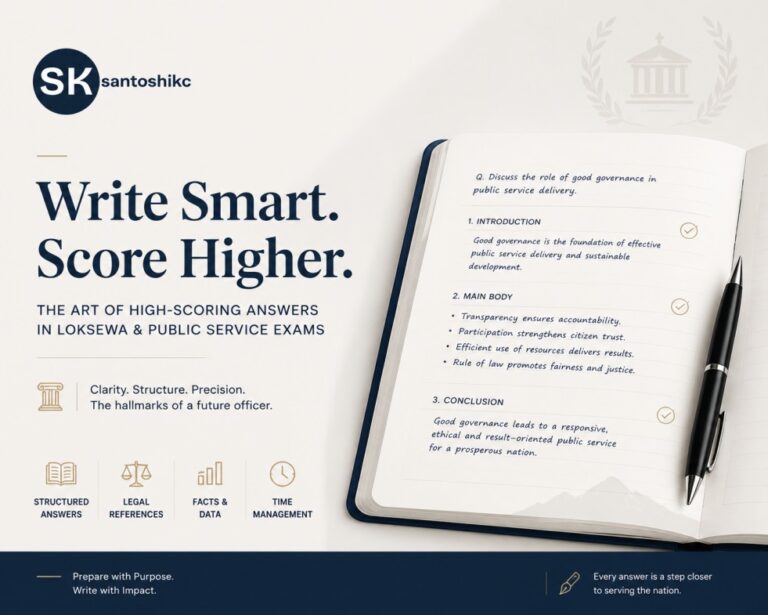
To master how to write subjective answers under a strict twenty-minute limit, I stopped focusing on flashy vocabulary and standardized my writing architecture:
- The Constitutional Anchor: Every answer must begin with the relevant article of the Constitution of Nepal. If you are discussing federalism, Articles 56 and 57 are your starting points; if you are discussing civil rights, Part 3 must be visible on your first page.
- The Institutional Mapping: Clearly identify which ministries, departments, or local government bodies are operationally responsible for the issue. This shows the examiner that you understand the actual operational machinery of the state.
- The Data Pivot: Ground arguments in the latest Economic Survey (Aarthik Sarvekshan) and National Planning Commission reports. Writing general statements gets you baseline marks; anchoring your paragraphs with official state data signals professional competence.
But structural writing requires emotional stability. And living alone in a fast city can break that stability fast…
Phase 4: Distance Is Not Isolation
Moving from Pokhara to Kathmandu as a fresh graduate, entirely on my own, was a deeply challenging experience. The capital moves at a fast, indifferent pace. There were many days when the absolute absence of familiar faces and the quietness of my rented room felt like a heavy physical weight. It is easy to feel completely forgotten in a city that doesn’t know who you are.
But during those long months, I came to realize that being physically alone is fundamentally different from being without support. My mother’s unwavering belief in me crossed the physical miles between us and sat with me at my study table every single morning.
The Power of Watching: She had spent most of her life working incredibly hard with very little margin for error. She did not need to give me long lectures about perseverance; I had grown up watching her live it every single day. That watching had become part of how I understood my own choices.
If you are preparing for this exam far from your home district, remember:
- The people who truly believe in your potential do not need to be in the same room to keep you going.
- If you lack immediate external encouragement around you, you must become your own standard.
- The deep, solitary discipline of showing up for yourself day after day, without needing anyone else to applaud your progress, is the exact foundation you need for a civil service career.
However, when the official exam dates approach, no amount of emotional baseline can stop the sheer panic of having only one shot…
Phase 5: Redirecting the Pressure of the Only Shot
I knew from the very first day I sat down at my desk that I was working with zero margin for error. The economic reality of my life meant I could not fail and simply choose to try again indefinitely without causing serious disruptions to my family’s timeline and to the expectations of the people who were counting on me.
That pressure was immense and entirely real. It is easy for outsiders to give shallow advice like “just don’t worry,” but when your livelihood depends on a merit list, worrying is a natural human response.
                  [THE PSYCHOLOGICAL CHOICE UNDER PRESSURE]

                         ┌──> Focus on Consequences ──> Mental Freeze & Anxiety
                         │
Pressure of "One Shot" ──┤
                         │
                         └──> Focus on Immediate Task ──> Micro-Progress & Calm
Whenever I felt the fear of failure rising—the paralyzing spiral of wondering what would happen to my life if my name did not appear on the final notice—I forced myself to return immediately to the physical work:
- I stopped talking about my fear with other candidates online.
- I stopped analyzing my percentages and chances.
- I simply opened my notebook to tackle the next practical task. If I was anxious about the governance paper, I forced myself to write out a full practice answer immediately.
Focused action is the only honest answer to the fear of failure. It does not make the difficulty disappear, but it redirects your nervous energy into the only variable you actually control: the quality of your preparation. The candidates who often collapse under exam pressure are those who spend more time worrying about the outcome than fixing their structural weaknesses. The study itself becomes the mechanism that stabilizes your mind.
But what about the persistent myth that the civil service is only for the privileged?
Phase 6: Your Background Is Not Your Ceiling
There is a quiet, deeply cynical narrative that runs through many social circles in Nepal: the whisper that the civil service is a closed system, reserved exclusively for candidates with elite backgrounds, wealth, or families already entrenched in the ministries.
Having access to premium study materials, an uninterrupted private environment, and total financial security removes daily survival stress. But those resources do not write the exam papers for you.
When you sit down in that examination hall, the question paper is absolutely identical for every single person in the room. It does not ask where you came from, what your parents do, or who you know in the capital. It demands to know what you understand and how effectively you can present a solution under immense time constraints.
[THE MERITOCRACY OF THE EXAM SHEET]
Your Background (Shapes the Difficulty) ───┐
                                          ├─> [THE QUESTION PAPER] ─> Determines Destination
Your Execution  (Shapes the Analysis) ────┘
I had been working since eighteen, fresh out of my Bachelor’s, and came from outside Kathmandu. I moved here alone, dedicated my time to intensive preparation, and navigated the entire process without a single guide in the bureaucracy. I passed on my very first attempt because the examination room remains a true meritocracy of execution.
Your background heavily shapes the difficulty of your journey, but it does not dictate its final destination. The qualities required to clear this exam—absolute consistency, complete honesty about your own weaknesses, and a refusal to give up when the daily routine feels stagnant and heavy—do not require money; they require character.
Phase 7: The Reality Beyond the Selection Notice
Passing the Lok Sewa examination is a profound milestone. Seeing your symbol number on the official selection notice brings a deep sense of validation that wipes away the memory of the cold mornings and the financial anxiety of the small rented room. But it is essential to look at this achievement with a long-term perspective.
When you clear the exam, you have not reached the end of the work; you have simply earned the right to begin it.
- The Internal Discipline: The intense self-discipline that got you through preparation is exactly what you need to navigate public administration.
- The Adaptability: The ability to produce results under imperfect conditions and limited resources is what makes you a competent officer.
- The Character: The commitment to absolute honesty developed when no one was watching is what protects your integrity in the system.
I wanted to join the civil service to earn the capacity to contribute to our society in a way that felt genuinely meaningful. That core reason does not expire the moment your results come out.
If you are sitting at your study table right now, waking up in the early mornings, managing tight schedules in a new city, and feeling the weight of a family that believes in you from a distance—understand that the very circumstances that feel like severe disadvantages are quietly building the stamina you need. Focus entirely on the immediate task before you, respect the structural requirements of the papers, and Trust the compounding value of your daily effort. If you apply these practical Lok Sewa first attempt tips with absolute consistency, you are much closer to the merit list than you think.