The Hidden Expiration Date of a Permanent Sarkari Jagir: 7 Brutal Realities of Modern Nepal’s Civil Service Career Growth
Achieving a steady Government Job Nepal Career Growth is supposed to feel automatic once you pass the Lok Sewa Aayog exams and get your permanent posting letter. Everyone tells you the exact same thing the moment you sign the attendance register for the very first time: “Relax now, you have made it. Your life is secure until retirement.”
For the first year, this narrative feels flawless. The predictable arrival of your salary brings immediate peace of mind, and the nightmare of memorizing thick general knowledge books is finally over.
But there is a massive twist nobody warns you about. That comfortable security has a sharp, hidden expiration date. While you are settling into a cozy daily routine of slow tea blocks and signing physical paper logs, the entire technological foundation of your career is being completely rewritten.
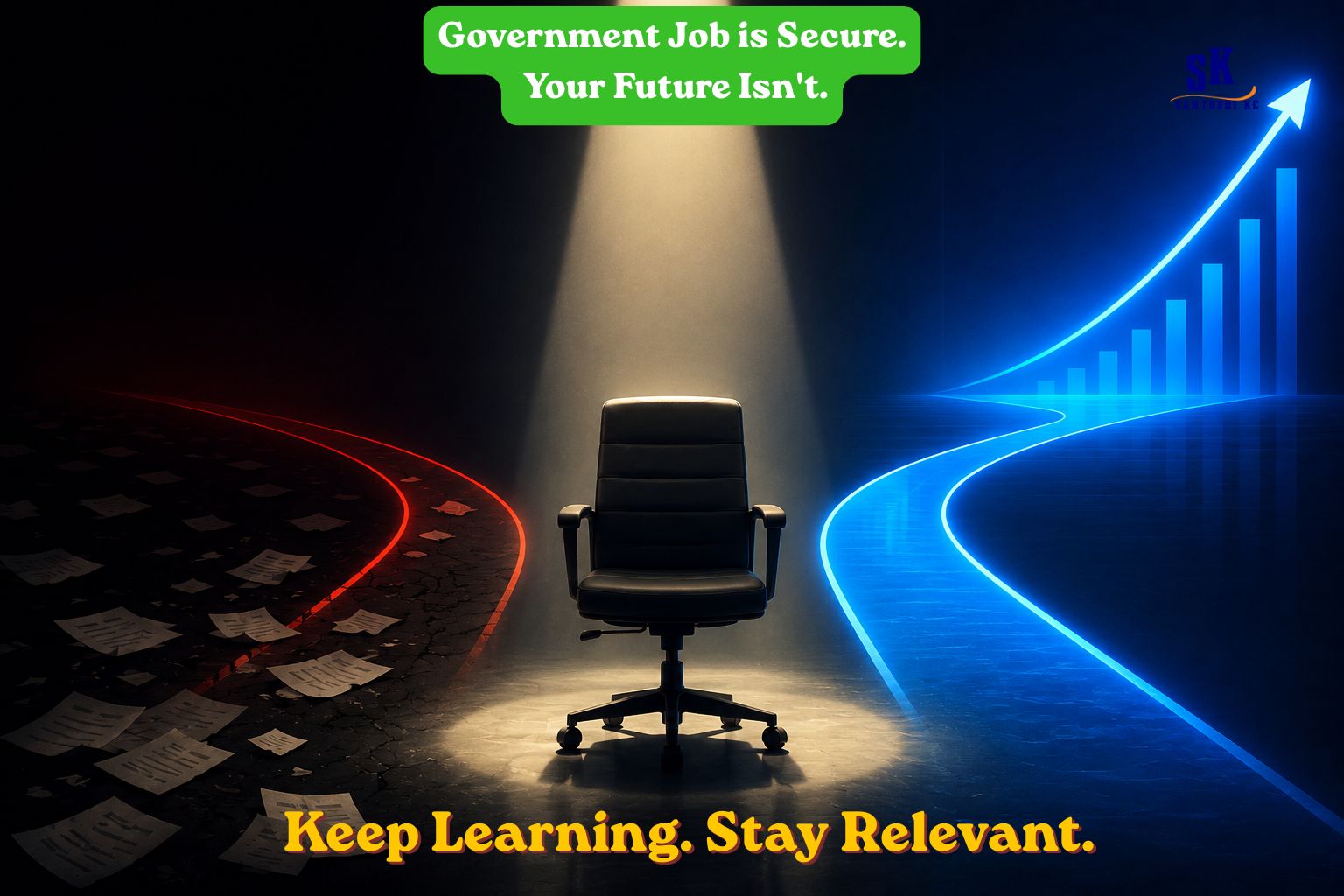
In today’s civil service, falling behind on digital tools won’t cost you your job, but it will completely cost you your relevance. The administrative world is moving forward at lightning speed, leaving tech-averse officers stranded at empty desks.
The Digital Architecture Overhauling Our Ministries
The push toward a digital administration in Nepal is no longer just a theoretical speech given at training centers. It is actively running on specific software systems that manage finances, track files, and monitor inventories across every single department every single day.
This modern digital infrastructure connects central budget allocations directly to daily departmental spending, changing how work actually gets done:
- File Tracking & Memos: Handled securely via GIOMS (Government Integrated Office Management System).
- Public Treasury & Revenue: Tracked dynamically through IPFMIS and RMIS.
- Property & Inventory Logs: Managed systematically via PAMS and NAMS.
- Citizen Interface: Streamlined through official departmental web portals.
1. The Death of Paper Memos: GIOMS
In the past, an official government memo (Tippani) required physical folders to be carried across multiple floors, often getting buried under a stack of other papers. With GIOMS, file registration (Darta), dispatch (Chalan), and tracking happen via secure digital signatures. The software creates a permanent record of exactly who held a file and for how many hours.
2. Tightening the Treasury: IPFMIS & RMIS
The management of public funds is governed by IPFMIS, while revenue is tracked via RMIS. These portals connect central budget allocations directly to daily departmental spending. The old manual ledger sheets—which were prone to calculation errors or strategic budget manipulation—are gone.
3. Inventory Accountability: PAMS & NAMS
Tracking everything from office laptops to project vehicles used to be done in massive, dusty physical logbooks (Jinsi Kitaab). Today, central web platforms like PAMS and NAMS automatically track depreciation, monitor current stock levels, and generate authentic audit trails that cannot be erased.
7 Brutal Truths About Government Job Nepal Career Growth
1. Digital Competence Outweighs Official Seniority
A high official rank no longer guarantees real influence inside an office. A senior officer might have fifteen years of experience and know the Civil Service Act by heart, but that knowledge stalls completely if they cannot navigate GIOMS.
When a department goes paperless, an officer who cannot use the system becomes entirely dependent on junior staff just to read an official letter. The real decision-making power silently shifts to those who can operate the software independently.
2. Manual Clutter is Disappearing into Real-Time Logs
Managing paper records manually used to be an absolute nightmare. Files went missing, handwriting was hard to decipher, and locating an old document from a dark storeroom took days.
[Old Manual Setup] ➔ [Systemic Portal Integration] ➔ [Real-Time Digital Records]
Centralized platforms keep data organized systematically in real time. This automated structure prevents simple data entry mistakes, ensures records are reliable, and makes daily work far more organized and satisfying for officers who want to get things done.
3. Real-Time Tracking Makes Performance Impossible to Hide
The integration of digital platforms brings total transparency to daily attendance and actual work hours. Modern biometric systems and digital footprints log exactly when an officer logs in and how long a file sits on their digital desk.
This tracking makes it impossible to hide delays or take credit for work you didn’t do. For dedicated civil servants, this is a massive win: it provides verifiable proof of your output, ensuring your efficiency cannot be brushed aside by office politics.
4. Objective System Data Shuts Down Favoritism
One of the best upgrades in the modern civil service is how technology weakens the traditional Afno Manche culture (nepotism and favoritism). In a paper-heavy office, assignments, travel opportunities, and performance evaluations often depended on personal relationships.
| Old Paper Bureaucracy | Modern Digital System |
| Project allocations done via personal preference | Financial tracking locked into IPFMIS logs |
| Asset distribution managed via loose paper receipts | Every single item tracked transparently in PAMS |
| File delays hidden in physical stacks | Time-stamped digital footprints on GIOMS |
When every transaction, budget use, and inventory change leaves an unalterable digital trail, decisions become visible to auditors. This shifts the focus away from personal favors and toward clear merit.
5. Authentic Audits End the Disaster of Bad Math
Year-end financial reconciliations used to be a chaotic nightmare of matching thousands of physical paper vouchers, receipts, and ledger books. A single mismatched number could hold up an entire department’s clearance for months, causing immense stress.
With IPFMIS and NAMS, internal and external auditors pull numbers directly from the system. Because the data is verified at the point of entry, auditing becomes accurate and fast, protecting clean officers from getting caught in administrative trouble caused by simple, accidental math mistakes.
6. The Technology Gap is Creating an Intense Generational Divide
The fast rollout of these portals has divided almost every government department into two distinct groups:
- The Tech-Smart Generation: Newly recruited officers enter the service with a natural comfort with computers and web portals. They find manual paperwork slow and frustrating, and they actively push for total digitalization.
- The Change-Resistant Generation: Many older, long-serving employees grew up entirely in a world of paper. They often view a new software rollout as an annoying burden, actively resisting the change.
Because of this gap, new recruits are quickly becoming the ones who drive core office operations, managing digital workflows and guiding their own bosses through system updates.
7. The Exam Tests Your Memory; The Career Tests Your Adaptability
The Lok Sewa Aayog examination is designed to test how much information you can memorize and write down on a single day. But the actual career that follows tests your ability to keep learning for the next thirty years.
[Phase 1: Lok Sewa Exam (Memory & Speed)] ➔ [Phase 2: Office Gates (Practical Transition)] ➔ [Phase 3: 30-Year Career (Digital Adaptability)]
Mastering a system like RMIS or GIOMS isn’t just about personal career survival. Every time you learn a system properly, a citizen standing at your counter gets their service in five minutes instead of being told to “come back tomorrow.” True career growth is about maintaining your usefulness to the public.
Small Habits That Keep You Ahead
You do not need an advanced computer science degree to excel in a digital ministry. Real growth comes from tiny, consistent actions:
- Read the Built-In System Manuals: Do not wait for your department to send you to a luxury hotel for a formal training seminar. Almost every portal has a “Help” or “User Manual” PDF link on its login page. Spend fifteen minutes reading it on your own.
- Master One Feature This Week: Don’t try to learn all of IPFMIS and PAMS in one afternoon. Focus on learning how to do one single task perfectly- like generating a specific revenue report or logging an asset purchase.
- Solve System Errors with Colleagues: When a portal crashes or a new update changes the layout, don’t just log out in frustration. Sit down with a tech-savvy colleague, figure out the workaround together, and note down the steps.
The Realities of Modern Bureaucracy
Formal promotions within the civil service remain bound by the traditional metrics of the Civil Service Act—focusing heavily on seniority points and written evaluations. However, the real-world currency of influence has fundamentally shifted. Officers who master digital tools are increasingly handpicked for strategic ministries, powerful secretariats, and key operational roles, accelerating their professional growth far ahead of their peers.
Crucially, this digital transformation is not confined to the halls of Singha Durbar. Because platforms like GIOMS, RMIS, and PAMS are entirely web-based, they function identically whether accessed from Kathmandu or a remote district headquarters. As long as an internet connection is active, the level of transparency remains uniform nationwide.
Navigating the friction between a tech-smart new generation and a change-resistant older establishment requires patience, not confrontation. When senior leaders realize that digital systems save them from signing thousands of physical pages, structural resistance naturally dissolves.
To the thousands of aspirants studying under desk lamps across Nepal: the civil service genuinely needs your energy and comfort with technology. However, entering this system merely to seek a safe, low-effort haven is a calculations mistake. True career survival now demands performance, continuous adaptability, and an unyielding commitment to delivering clean, immediate public service.
What has been your experience?
Which specific government software or digital workflow in your current office has made your daily tasks genuinely satisfying, and where do you still see older, manual habits slowing down public service delivery? Let us know in the comments below!