

Government Jobs in Nepal 2026 (2083): Jobs, Salary, Vacancies & How to Apply
Last updated: Asoj 2083 (September 2026)
Every Dashain, somewhere between the tika and the khasi ko masu, a relative asks it: “Jagir khayau?”
And most of us give the same answer. “Loksewa ko tayari gardai chhu.”
I’ve been a government officer for almost nine years. I want this guide to give you a better answer than that.
Below is the full list of government jobs in Nepal (sarkari jagir), the real seat numbers, the new salary and exactly how to apply.
Stay till the end. The last part is the one most aspirants skip, and it decides who actually gets in.
Looking for one service? Jump to it from the table of contents: Civil service, Teaching, Bank, Army, Police, APF, Health or Technical.
List of government jobs in Nepal (2026)
Loksewa (Lok Sewa Aayog) is the biggest door, but it’s far from the only one.
| Career | Who can enter (yogyata) | Age (umer hada) |
|---|---|---|
| Civil service | SEE, +2 or bachelor’s | 18 to 35* |
| Province and local | Assistant or officer posts | Per notice |
| Teaching | Bachelor’s + licence | 18 to 40 |
| Nepal Army | +2 or bachelor’s | 18 to 21 or 24 |
| Nepal Police | Class 8, +2 or bachelor’s | 18 to 25 |
| APF | +2 or bachelor’s | 18 to 25 |
| Rastra Bank | +2 (Assistant) | 18 to 35* |
| Health | Health degree + council | Per post |
| Technical | Diploma or degree | Per post |
*Women and persons with disabilities up to 40 in civil service; women up to 40 at Rastra Bank. The exact post and age for each path are in the sections below.
Source: PSC notices 651, 903 and 1058 (2082/83) and the latest notices of each body. Accounts, revenue and justice groups ask for specific subjects, so read the notice for your group.
Look at that table again, because three things in it surprise most people.
The uniform has a deadline. You can sit for Section Officer until 35. But a Police Inspector must be 25 or younger, and an Army officer cadet with +2 must be 21 or younger.
If you’re 19 and even slightly interested in a uniform, your window is open right now. And it closes fast.
Loksewa prep works beyond Loksewa. The Public Service Commission also conducts the written exams for Army officer cadets, Police constables, ASIs and Inspectors, and APF posts. Your preparation isn’t wasted if you try a second door.
There’s a second civil service. Provincial public service commissions hire for provincial ministries and local levels (gaunpalika and nagarpalika) under the Provincial Civil Service Act 2080 and the Local Civil Service Act 2081. Plenty of aspirants never even check their notices.
One new rule is worth knowing too. From FY 2082/83, Kharidar-level non-technical posts in organised institutions require you to pass a pre-qualification exam (purba yogyata pariksha) before you can apply.
So that’s the map. Now the part nobody likes to talk about: how many seats are actually there?
How tough is the competition?
For one Kharidar-level advertisement handled by the PSC Kathmandu office, 2,079 candidates sat the written exam (likhit pariksha) for 47 vacancies. That’s about 44 people for every seat, in one office, in one round.
Here’s what recent notices offered for the whole country:
| Recent notice | Seats |
|---|---|
| Section Officer, civil and justice (Mangsir 2082) | 250 |
| Nepal Police Inspector (2082/83) | 21 |
| Nepal Police ASI (2083/84) | 211 |
| Nepal Police Constable (2082/83) | 1,553 |
| APF Inspector (2082/83) | 41 |
| APF ASI (2082/83) | 131 |
| Army Officer Cadet (2083/84) | 280 |
| Secondary teacher (Magh 2082) | 449 |
Twenty-one Police Inspector seats for all 77 districts. And of those 250 Section Officer seats, only 70 were open (khula) seats in general administration (samanya prashasan), the post most people prepare for.
If your stomach just dropped a little, that’s fair. But keep reading, because these numbers are only half the story.
Why those numbers shouldn’t stop you
Forty-four people in a hall isn’t forty-four equal rivals. The form costs Rs 500, and anyone can fill it. The real question is how many of those 44 studied from the current syllabus, solved past papers and walked in with a plan. Which group you’re in is up to you.
The first phase is a gate, not a verdict. In the Kharidar exam, you need 45 percent in the first phase (pratham charan) to move on, and those marks aren’t added to your final score. Learn its pattern, clear it, then give everything you have to the second phase.
You’re allowed more than one door. With +2 at age 20, you can prepare for Nayab Subba, Police or APF ASI, and provincial assistant posts at the same time. They open at different times, and much of the preparation overlaps.
Most people bet everything on one exam. You don’t have to.
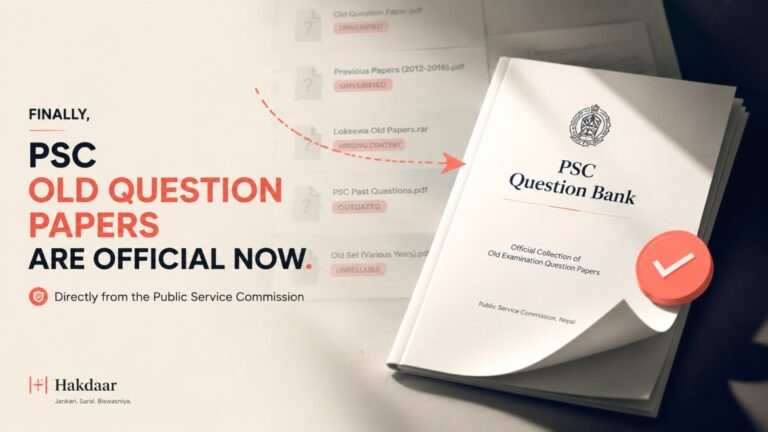
The questions aren’t secret. PSC publishes past papers in its own official question bank. Nobody has a better source than you do.
And a door is open right now. Nepal Police has announced 211 ASI seats. Applications run from 2083/06/12 to 2083/07/10 at careers.nepalpolice.gov.np. You need +2 and must be 18 to 24.
So yes, you can get in. The next question is what it’s worth once you do.
Government job salary in Nepal 2083/84 (sarkari talab)
A new salary scale started on Shrawan 1, 2083, the first basic pay rise in four years. The Cabinet approved it on 2083/04/06, and the Ministry of Finance circulated it on 2083/04/20.
On top of basic salary (suru talab), you now get a 10 percent monthly incentive allowance (protsahan bhatta) and a Rs 5,000 dearness allowance (mahangi bhatta). This is day one, before grades, tax and provident fund:
| Post | Basic salary | Total per month |
|---|---|---|
| Kharidar | Rs 36,192 | Rs 44,811 |
| Nayab Subba | Rs 38,203 | Rs 47,023 |
| Section Officer | Rs 48,058 | Rs 57,864 |
Remote postings add a remote-area allowance (durgam bhatta), and each year of service adds a grade (grade rakam) worth one day’s basic pay. Provident fund (sanchaya kosh) and tax are deducted from your pay.
Three things in these numbers should shape your plan.
The big jump is at officer level. Nayab Subba starts only Rs 2,011 above Kharidar. Section Officer starts Rs 9,855 above Nayab Subba. If you have a bachelor’s degree, or can finish one, aim higher.
Grades are slow. A Kharidar who collects all ten grades reaches Rs 48,252 in basic pay. That’s roughly what a Section Officer earns on day one.
The same level pays the same, whatever the uniform.
Rs 48,058 starting basic: Section Officer, Police Inspector, APF Inspector, Army Sahayak Senani, Health Officer (6th level), Secondary teacher (third class)
Rs 38,203 starting basic: Nayab Subba, Health Sahayak (5th level), Lower secondary teacher (third class)
Rs 36,192 starting basic: Kharidar, Police and APF ASI, Health Sahayak (4th level), Primary teacher (third class)
Rs 28,690 starting basic: Police Jawan, APF Jawan, Army Sipahi
A Police Inspector and a Section Officer start on exactly the same basic pay. One spends the day on files and meetings, the other on patrol and investigation. Money can’t make this choice for you. The work has to.
Source: Ministry of Finance, Budget and Programme Division, letter on the new salary scale and facilities, 2083/04/20.
Which government job fits you? Every path, one by one
Since the pay is the same at each level, the real question is simple: what would you be happy doing on an ordinary Tuesday, ten years from now? Here’s what each path actually looks like from the inside.
Civil service (Nijamati sewa)
This is what most people mean when they say “Loksewa.” The work is files, rules, letters, coordination, decisions and people who come to the office with a problem. If you like reading, writing, analysing and working inside a system, you’ll probably do well here.
Entry: Kharidar after SEE (GPA 2.0 or above), Nayab Subba after +2, Section Officer (Shakha Adhikrit) after a bachelor’s.
Ages are 18 to 35, or 21 to 35 for Section Officer, with women and persons with disabilities allowed up to 40.
If you’d rather be in the field, in a classroom or doing hands-on technical work, one of the paths below may suit you better.
Province and local government (Pradesh ra sthaniya taha)
The work is similar to federal civil service, but you serve a province or a gaunpalika or nagarpalika instead of the whole country.
Each province’s Lok Sewa Aayog runs its own recruitment, notices and portal. If you only follow the federal calendar, you’ll miss these. Check your province’s commission regularly.
Teaching (Shikshak)
Liking a subject isn’t the same as liking to teach it. A teacher plans lessons, checks work, manages a classroom and talks to parents. It’s a people job from morning till afternoon.
So ask yourself one honest question: would I be comfortable spending most of my working day with students?
If yes, the path runs through Shikshak Sewa Aayog. For a secondary teaching licence (adhyapan anumatipatra), you need a bachelor’s plus 10 months of training in education, or a bachelor’s in subjects such as science, maths or English.
The latest notice had 449 secondary teacher (Madhyamik shikshak) seats. A third-class secondary teacher starts on the same basic pay as a Section Officer.
Banking (Nepal Rastra Bank and public banks)
People often put “bank job” and “government job” in separate boxes. Public financial institutions are both: structured and relatively stable, but with very different work from an administration office. You deal with customers, accounts, loans, risk, technology and daily operations.
If numbers, finance and business excite you more than rules and files, this path may make more sense than years of general administration preparation. Nepal Rastra Bank‘s Assistant (Sahayak) post needs +2 and an age of 18 to 35 (women up to 40). Each public bank publishes its own notices.
Nepal Army (Nepali Sena)
A completely different life from an office. Discipline, training, physical fitness, teamwork, postings and field duty. For someone who wants that life, it can be deeply rewarding. For someone who only wants a secure, respected job title, it can be very hard.
The latest officer cadet (Adhikrit Cadet) notice had 280 seats. You need +2 (age 18 to 21) or a bachelor’s (up to 24), maths as a compulsory SEE subject, and you must be unmarried.
Graduate cadets go through 12 months of basic military training. Women serve in combat-related, combat support and service support roles, though not in direct front-line combat units.
Nepal Police (Nepal Prahari)
Law enforcement, investigation, public safety, emergencies and constant contact with people. It isn’t a normal office job, and it isn’t meant to be.
Entry: Constable (Prahari Jawan) after class 8, age 18 to 23. ASI (Sahayak Nirikshak) after +2, age 18 to 24. Inspector (Prahari Nirikshak) after a bachelor’s, age 20 to 25.
Nepal Police also hires technical staff, such as IT and communication Inspectors, SIs and ASIs. Everything is published at careers.nepalpolice.gov.np.
One piece of advice: look at the actual job, not the name of the post.
Armed Police Force (Sashastra Prahari Bal)
Security and field-oriented work, with a selection process that tests your body before your pen: physical tests, an endurance test and medical exams come alongside the written exam, which the PSC conducts.
Entry: ASI after +2 (age 18 to 23), Inspector after a bachelor’s (21 to 25). APF also recruits doctors, nurses, law and accounts officers. Applications go through bhana.apf.gov.np. Before applying, find out what that specific post involves every single day.
Health services (Swasthya sewa)
If you’re studying medicine, nursing, pharmacy or public health, your path is already more specialised. Your question isn’t really “which government job should I choose?” It’s this: where can I use the profession I’ve spent years learning?
Government hospitals, PSC health service posts and even the security forces hire health professionals. Almost every post asks for registration with your professional council, so keep that registration valid.
Engineering, IT and technical jobs
Not every government job is administration. Offices and institutions need engineers, IT professionals, agriculture and forestry specialists and lawyers.
If you’ve spent years building a technical skill, don’t assume you have to leave it to get a government job.
A Technical Police Inspector (IT) post, for example, asks for computer engineering or a CSIT, BIT or BCA background. There are fewer seats, but only people with your kind of degree can compete for them.
What no vacancy notice tells you
This is the part I promised at the start. It’s also the part I wish someone had told me.
Your family is preparing with you
Behind most Loksewa aspirants there’s a family. A father who remembers the form deadline before you do. A mother who can’t tell Kharidar from Nayab Subba but still gets up early to make tea when you study.
Their hope matters, and it deserves respect. But you’re the one who will walk into that office every day for the next twenty or thirty years. Make the choice with them, not only for them.
One day, someone will stand at your desk
This is the moment a government job becomes real.
Someone will come to your desk holding a file. They may have left home before sunrise to reach the office. It may be their third visit for the same work.
At that point the job isn’t about your rank or your salary anymore. It’s about whether that person goes home with their work done.
That’s the part of this job that no salary table shows, and it’s the reason many of us stay.
[OFFICER’S EXPERIENCE: one real moment from your service when a citizen’s problem stayed with you: what they needed, what you could or couldn’t do, and what it taught you. No names, no office details, no confidential information.]
Transfers (sarua) come with the job
In civil service, the security forces and many public institutions, being posted to another district is normal. You may spend some festivals away from home, and you’ll learn a new place and new ways of working.
Some people love that part of the career, and for others it’s the hardest part. Better to know which one you are before you choose.
[OFFICER’S EXPERIENCE: one or two lines on what a posting away from home taught you, without personal details]
Not passing once doesn’t close the door
Result (nateeja) day has a particular kind of silence. You open the list, search for your roll number, and it isn’t there.
It hurts, and it can feel like everyone else is moving ahead without you. But ask around in any government office and you’ll meet people who didn’t pass on their first try.
One result doesn’t decide what you’re worth. Look at where you lost marks, fix your plan, and sit the next round stronger than the last.
How to apply for government jobs in Nepal: 5 steps
Where to apply:
- Civil service: psconline1.psc.gov.np
- Province and local: your province’s Lok Sewa Aayog site
- Teaching: tsc.gov.np
- Police: careers.nepalpolice.gov.np
- APF: bhana.apf.gov.np
- Army: vacancy.nepalarmy.mil.np
The steps:
- Find the official notice (bigyapan) on one of the sites above.
- Read the eligibility line by line: subject, level, group, age, licence, physical standard. Result out but no original certificate yet? PSC lets you apply with your marksheets and a letter from your college.
- Check your group. Open (khula) and inclusive (samawesi) groups have separate seats. In combined exams, apply for all your groups in one go.
- Pay before the deadline. PSC fees were Rs 500 for Kharidar, Rs 700 for Nayab Subba and Rs 1,200 for Section Officer. Seven extra days are allowed with a double fee (dobbar dasturi), but they don’t count for age or qualification. The Army and APF also need your printed form in person.
- Download the syllabus (pathyakram) from the same notice. Prepare from that version, not an old one.
Fake vacancy posts do go around on social media, and some ask for money. If you can’t find the same notice on the official website, don’t pay and don’t send documents.
If you’re abroad and thinking of coming back
A degree from abroad needs an equivalence certificate (samakakshata) from Tribhuvan University or its Curriculum Development Centre, and PSC wants it done by the application deadline. You also need Nepali citizenship (nagarikta), and every exam and interview (antarbarta) happens in Nepal. Start the paperwork early.
Your next seven days
Reading this was step zero. Here’s what the next week can look like:
- Today: open one official notice for a post you qualify for and read the eligibility section fully.
- Tomorrow: check your age against every service in the list above. Write down which doors are open for you, and until when.
- Day 3: download the syllabus for your target post from that notice.
- Days 4 and 5: solve one full past paper from the PSC question bank. Mark every question you couldn’t answer.
- Day 6: talk to one person already in the service about their ordinary week.
- Day 7: choose your first door and your backup door.
Seven days, no coaching fee, and you’ll already be ahead of the people who only filled the form.
So, “Jagir khayau?”
Next Dashain, when someone asks you that question, you won’t need a job title to answer it with confidence.
“I know which door I’m going for, and I’ve already started.”
That answer beats “tayari gardai chhu” every time.
Frequently Asked Questions
What is the list of government jobs in Nepal?
Civil service, teaching, Nepal Army, Nepal Police, Armed Police Force, Nepal Rastra Bank and public banks, health services, and engineering, IT and technical posts in public institutions.
How to get a government job in Nepal?
Find the official vacancy notice, check every eligibility condition, apply online before the deadline, and prepare from the syllabus published with that notice.
Is Loksewa the only way to get a government job in Nepal?
No. Teachers are recruited through Shikshak Sewa Aayog, security forces run their own recruitment, and provincial and local posts go through provincial public service commissions. The PSC still conducts the written exams for Army, Police and APF.
What government jobs can I get after SEE or +2?
After SEE, Kharidar (GPA 2.0 or above). Class 8 is enough for Police Constable. With +2, Nayab Subba, Police and APF ASI, Army officer cadet and Nepal Rastra Bank Assistant, among others. Full guide: Government Jobs After +2 in Nepal.
What government jobs can I apply for after a bachelor’s degree?
Section Officer, Police and APF Inspector, Army officer cadet (up to age 24), secondary teacher with a teaching licence, and technical posts that match your subject. If you’re also weighing private jobs, read Government vs Private Job in Nepal.
What is the salary of a Section Officer in Nepal in 2083/84?
The starting basic salary is Rs 48,058. With the 10 percent incentive (protsahan bhatta) and Rs 5,000 dearness allowance (mahangi bhatta), it’s Rs 57,864 a month before grades, tax and provident fund.
What is the age limit for government jobs in Nepal?
Civil service: 18 to 35, up to 40 for women and persons with disabilities, and at least 21 for Section Officer.
Security forces are stricter: Police Constable 18 to 23, ASI 18 to 24, Inspector 20 to 25. Army officer cadet: 18 to 21 with +2, or up to 24 with a bachelor’s.
Where can I check government job vacancies in Nepal in 2026?
Only on official websites: psc.gov.np, your province’s Lok Sewa Aayog site, tsc.gov.np, nepalarmy.mil.np, nepalpolice.gov.np, apf.gov.np and nrb.org.np.
==================== ARTICLE BODY ENDS HERE ====================
==================== RANKMATH SETTINGS ====================
SEO Title (59 characters): Government Jobs in Nepal 2026: List, Vacancy & How to Apply
Meta Description (135 characters): Full list of government jobs in Nepal 2026 with age limits, new 2083/84 salary, seats and how to apply. Checked by a government officer.
Slug (unchanged): government-jobs-in-nepal
Focus Keywords (5): government jobs in Nepal, list of government jobs in Nepal, government job vacancy in Nepal, how to get government job in Nepal, civil service jobs Nepal
Feature image file name: government-jobs-in-nepal-2026.jpg (at least 1200px wide)
==================== BEFORE YOU PUBLISH ====================
- Fill in both [OFFICER’S EXPERIENCE: …] spots with your own lines.
- Move the 8 FAQ questions into the RankMath FAQ block, then delete the FAQ headings from the body.
- After 2083/07/10, update the “a door is open right now” paragraph with the next open vacancy.
- Check how the tables look on your phone before publishing.
- Update the “Last updated” date, then request indexing in Search Console.





2 Comments