Gazetted Meaning in Nepali: 4 Differences Most People Get Wrong
Last updated: September 24, 2026
Quick answer: The gazetted meaning in Nepali is Rajpatrankit, and non-gazetted means Rajpatra Anankit. In Nepal’s civil service, Section Officer and the posts above it are gazetted. Kharidar and Nayab Subba are non-gazetted.
In many Nepali homes, one sentence carries a whole family’s hope: “Hamro chhora wa chhori gazetted officer bannu parchha.”
Parents say it at weddings, at tea shops, and on phone calls to relatives abroad. For them, gazetted means respect. It means their child made it.
I understand that hope. I joined Nepal’s civil service directly at officer level on my first Lok Sewa attempt, and I have worked in gazetted posts for nearly nine years. But over these years, I have learned something most people outside the system never hear. The word “gazetted” means less than people think. And the people it leaves out matter more than people think.
Let me explain it simply.
Which Posts Are Gazetted and Which Are Non-Gazetted?
To begin with, here are the posts you hear about most in the Nepal Administration Service:
| Post | Classification |
|---|---|
| Kharidar | Non-Gazetted Second Class |
| Nayab Subba (Na. Su.) | Non-Gazetted First Class |
| Section Officer (Shakha Adhikrit) | Gazetted Third Class |
| Under Secretary (Upasachiv) | Gazetted Second Class |
| Joint Secretary (Sahasachiv) | Gazetted First Class |
| Secretary (Sachiv) | Gazetted Special Class (Bishisth Shreni) |
Gazetted posts have four classes: Special, First, Second and Third. Non-gazetted posts have their own classes too.
What Does Gazetted Mean in Nepali?
Gazetted means Rajpatrankit. It is a label given to higher-level posts in government service.
The label tells you three things about a post: where it sits in the service, how much responsibility it usually carries, and which career path it belongs to.
So when someone says, “Uha ta Gazetted Third Class officer ho,” they are telling you the level of that post. That’s all. It is not a measure of the person’s worth.
What Does Non-Gazetted Mean?
On the other hand, non-gazetted means Rajpatra Anankit. These are posts below the gazetted level, such as Kharidar and Nayab Subba.
But please don’t read “non-gazetted” as “less important.”
Think of the Kharidar who reaches the office before it opens, sorts the files, and finds the one document you thought was lost. Think of the Nayab Subba who handles application after application, day after day, so that someone’s citizenship, pension or land record moves forward.
Their post is non-gazetted. Their work is not small. Without them, no government office in Nepal can run for a single day.
Why Is It Called “Gazetted”? (Nepal Gazette Meaning)
So where does the word come from? It comes from the Nepal Gazette (Nepal Rajpatra), the Government of Nepal’s official publication. Laws, regulations, appointments and important government notices are formally published in it. You can see it on the official Nepal Rajpatra website.
Today, however, gazetted is a classification of the post. It doesn’t simply mean that someone’s name appeared in the Rajpatra. Think of it as a label on the post, not on the person.
The Biggest Misunderstanding About Gazetted Officers
Imagine an elderly man from a village. He has travelled since early morning, his documents wrapped carefully in a plastic bag. He waits in line. At the counter, he hears: “Yo file mathi pathaunu parchha.”
His shoulders drop. He thinks, “Thulo officer bhetna paaye, kaam hunthyo.”
Here’s the part most people miss: the biggest officer is not always the right person for his file.
Being gazetted does not mean a person can approve everything. Who can sign, approve, certify or decide a matter depends on the authority given to that post by law, rules or delegation. Sometimes it’s a gazetted post. Sometimes it isn’t.
If someone had told that man to ask one simple question, “Who has the authority for my matter?”, he might have saved a whole day of his life. That is why this difference matters.
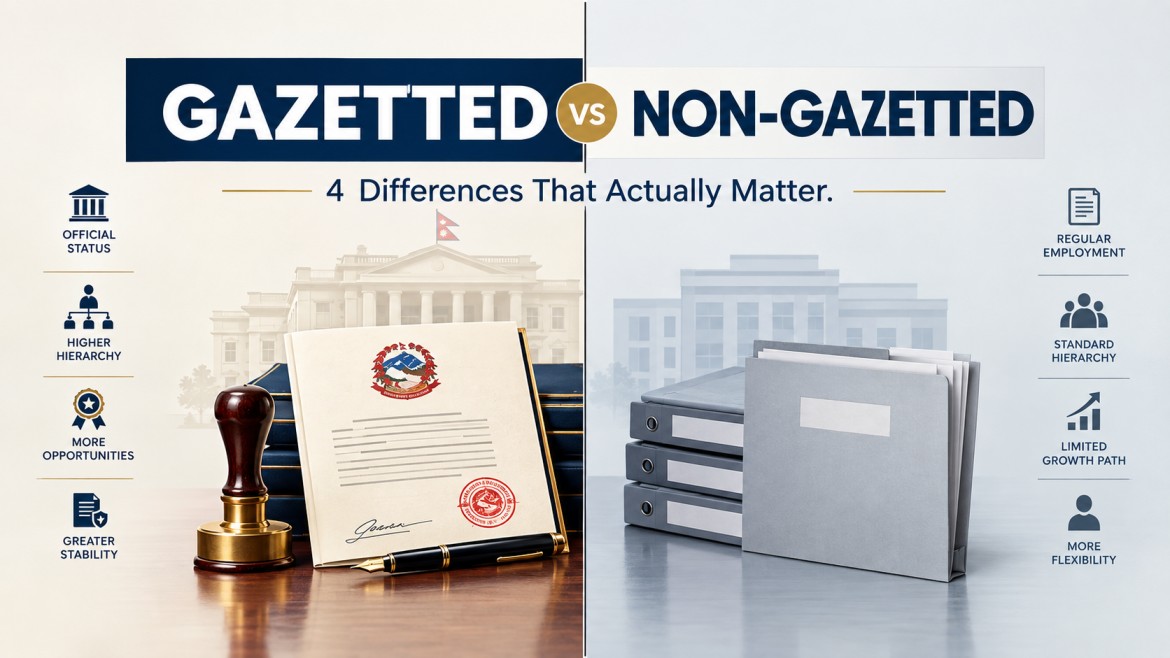
4 Differences Most People Get Wrong
Now that the basics are clear, here are the four differences that actually matter.
1. They sit at different levels. Gazetted and non-gazetted posts are different levels of the same service. Gazetted posts usually carry more supervisory or decision-making responsibility.
2. Authority comes from the post, not the title. As we just saw, the power to decide depends on what authority has been given to a post, not on whether it’s gazetted.
3. Entry requirements are different. Also, each post has its own rules for education, age and eligibility. There is no single rule for all gazetted or all non-gazetted jobs, so always read the vacancy notice for your post.
4. It’s one career path, not a wall. Finally, non-gazetted is not a dead end. Through promotion and competition, people move up over the years. If you are starting as a Kharidar or Nayab Subba, hold your head high. The ladder is there. Baato chha, tara kun post, kun sewa ra kun niyam lagu hunchha, tyasle farak parchha.
What This Means When You Visit a Government Office
So what does all this mean in real life? Next time your file is sent “mathi,” don’t assume someone is avoiding you. Often, the first desk has done everything that post is allowed to do, and the next step needs another designated authority.
Ask politely, “Who is the right authority for this matter?” It’s a small question, but it can save you hours, sometimes days. The goal is not to reach the biggest officer. It’s to reach the right one.
The Real Meaning of Gazetted
So the next time you hear a parent say, “Gazetted officer bannu parchha,” remember this.
Gazetted is a level of post. It is written in rules and printed in notices. But what makes a civil servant truly respected is not the class of their post. It is how they treat the person standing at the counter with a plastic bag of documents and a long day behind them.
After nearly nine years in this service, that is the meaning I hold on to.
Quick Recap
In short:
- Gazetted = Rajpatrankit. Non-gazetted = Rajpatra Anankit.
- Section Officer and above are gazetted. Kharidar and Nayab Subba are non-gazetted.
- These labels classify posts, not people.
- Being gazetted doesn’t mean authority over every matter.
- Non-gazetted work is the backbone of every government office.
Preparing for one of these posts? Our guide to PSC old question papers shows how to practise the right way. Still choosing your path? Read Government Job vs Private Job vs Abroad. For official links to everyday government services, visit our Citizen Portal Nepal.
Gazetted Meaning in Nepali: Frequently Asked Questions
What is the meaning of gazetted in Nepali? Gazetted means Rajpatrankit. It is a classification of higher-level government posts, such as Section Officer and above.
What does non-gazetted mean? Non-gazetted means Rajpatra Anankit. In the Nepal Administration Service, Kharidar and Nayab Subba are non-gazetted posts.
Is Nayab Subba a gazetted post? No. Nayab Subba is a non-gazetted first class post.
Is Section Officer a gazetted post? Yes. Section Officer (Shakha Adhikrit) is a gazetted third class post.
What is the Nepal Gazette? The Nepal Gazette (Nepal Rajpatra) is the Government of Nepal’s official publication, where laws, regulations, appointments and important government notices are formally published.