They Vanished in Nepal’s Flood for 9 Days. What Rescuers Found Left Everyone in Tears.
Two Nepal flood survivors went to work that morning, like any other day. Two families waited nine days without a single word. Then the darkness finally broke, and both men came home — a rare piece of good news in a disaster where thousands are still missing.
This is the story of Kabir Maharjan and Sanjay Sah — two Nepal flood survivors, two families, one survival that almost didn’t happen.
“There Won’t Be Any Network Inside”
On the morning of August 26, 2026, Kabir Maharjan called his wife before his shift at the Upper Trishuli 3A hydropower project in Rasuwa.
“I have to go inside the tunnel,” he told her. “There won’t be any network inside.”
It was such a small, forgettable moment — a husband telling his wife he’d be out of reach for a few hours. Neither of them knew it would be nine days before she heard his voice again.
Nearby, in the same power station, engineer Sanjay Sah was starting his own shift, in the control room.
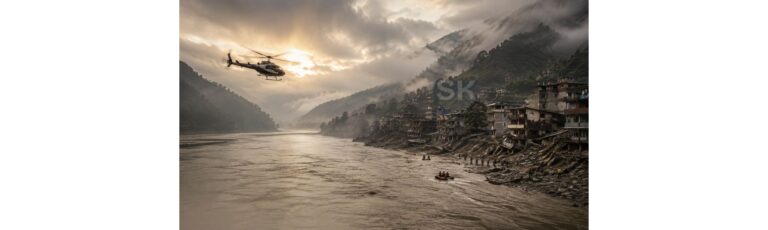
About an hour later, a glacier broke apart on the Langtang Lirung mountain, upstream. A wall of mud and water crashed through the valley. It swallowed homes, roads, and a row of hydropower stations — with hundreds of workers still inside, including Maharjan and Sah.
In Kathmandu, engineers watching the power grid on their screens saw stations go dark, one after another, like a string of lights switching off.
Two Men, Running From the Same Flood
When the order to leave finally came, Sah ran from floor to floor of the power house, warning everyone he could find. Maharjan tried to get out too.
Both men ran from the rising water — and both ended up in the same place: a narrow tunnel that sloped upward, just 160 meters from the exit, now sealed off by tons of mud and rock as the flood closed in behind them.
It was not safety. It was just a pocket of air. But that was enough to keep two men alive, together, in the dark.
How the Nepal Flood Survivors Stayed Alive for Nine Days
For the next nine days, that small space was their entire world. And maybe having each other there was the only thing that kept both of them from losing hope completely.
Sah prayed, over and over, just to hold onto his courage in the dark. Maharjan grew weak and confused, and drank the same muddy water he was lying in — because it was the only water there was.
No light. No sound but their own breathing, and water dripping somewhere in the dark. Two men, side by side, not knowing if the world above still remembered them.
Above ground, both families were living their own version of that same darkness. Maharjan’s wife, Hira Shova, called his phone again and again — nothing. She held her fear inside so her two young sons wouldn’t see it. Sah’s family waited too, with no more information than anyone else had: only silence.
A Rescue That Refused to Give Up
Rescuers faced a mountain that fought them at every step. “Everything you drop on that place just goes under,” one geologist on the team said — the mud was too soft and wet for machines to even move on.
It took nearly three days before serious digging could even start, and nearly six more before rescuers reached the tunnel’s buried entrance. Rain kept undoing their work, filling shafts with fresh mud almost as fast as crews could clear it.
Every day without an answer made it harder to believe there was anyone left to find. But rescuers kept digging — for both men they didn’t yet know were still alive, together, waiting. (Read the full story of that race against time: Nepal Flood Rescue: Race to Save Lives in Rasuwa)
One Word, for Both of Them
Before dawn on the tenth day, a rescue worker heard something. A sound. Maybe a voice. Maybe just an echo bouncing back through the tunnel.
Rescuers turned off their machines and listened. They called into the dark, again and again: “Where are you? Are you there?”
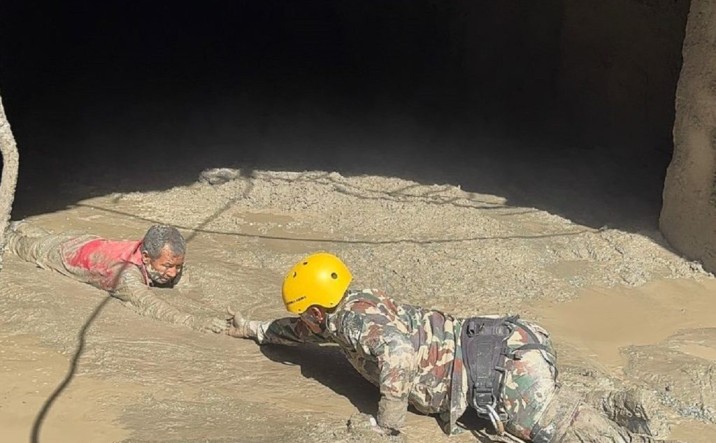
Slowly, the sound grew closer. Then, in the beam of a headlamp, someone saw a hand reaching out of the mud.
Soldiers broke through the last stretch of mud. And from the darkness came one word, meant for both men still alive inside: “hunuhuncha” — we are here.

Two Reunions
Neither man could stand on his own when they were finally pulled into daylight.
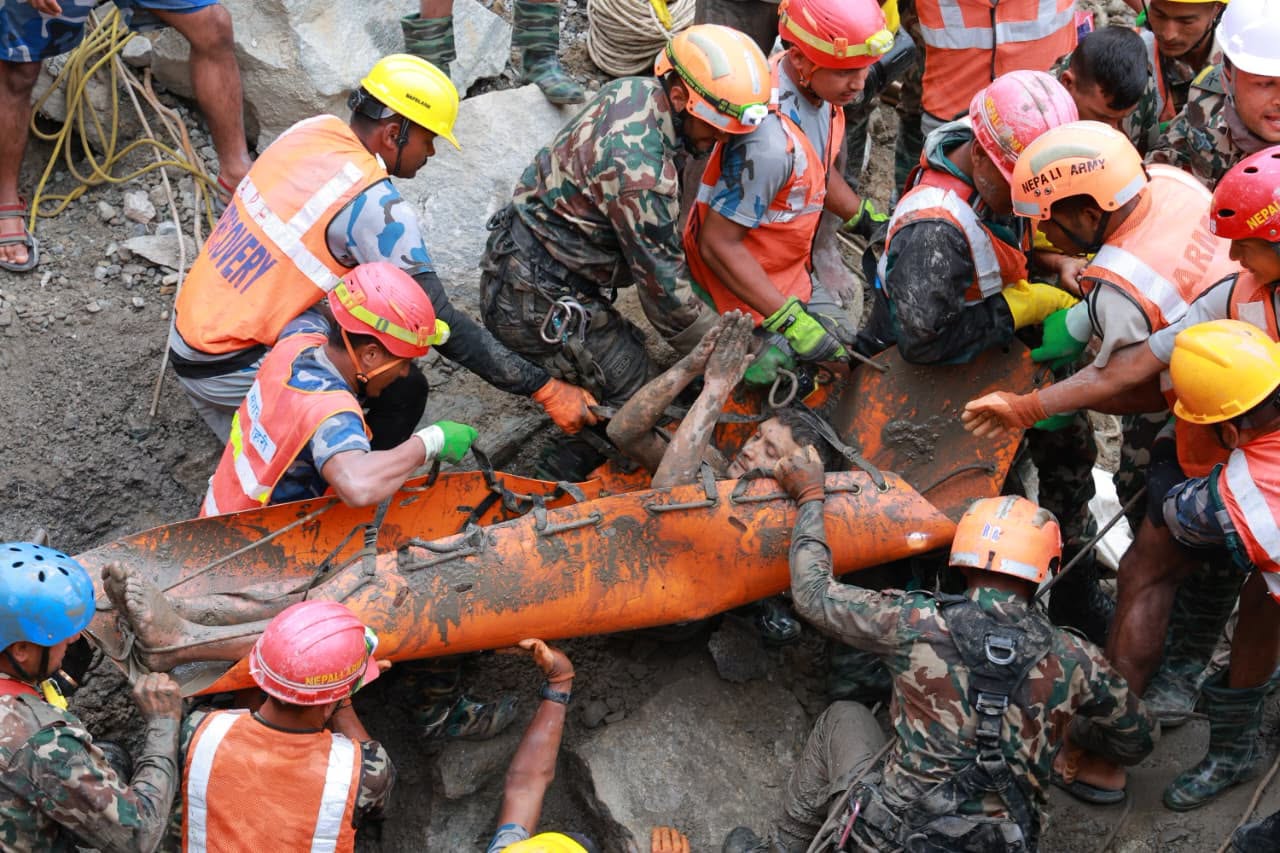
Sah was carried out first, on a rescuer’s back, mud caked on his face — one hand lifted weakly toward the camera. Moments later, Maharjan, more badly hurt, was carried out on a stretcher.
At Maharjan’s home, his sons shouted the moment they heard: “Mummy, Papa is back!” At the hospital, when his wife walked into his room, he looked at her — and didn’t recognize her. Nine days in the dark had left him confused. He asked why she hadn’t given him a bed sooner. She didn’t correct him. She just held his hand, grateful to have him back at all.
“He is blessed with another life,” she said.
The same prayers that had kept Sah going in the dark were, somewhere above ground, very likely being said for him too — in a home that had spent nine days holding its breath, waiting for a call that finally came.
Why We Are Telling This Story
Behind every number in this disaster is someone’s husband, someone’s father, someone’s son — two men, two families, and thousands more still waiting for a phone call that hasn’t come. This disaster is still unfolding, and the confirmed death toll keeps rising. (For the current verified death toll and missing-persons numbers, checked against NDRRMA, see our Nepal Flood Missing List — and if you are searching for a missing loved one, that same guide shows you how to report and search.)
Kabir Maharjan and Sanjay Sah — two Nepal flood survivors who both made it home. Their story does not undo the scale of this tragedy, or the thousands of families still waiting without answers. But it shows that even after nine days of silence, in the middle of a disaster this large, hope can still be found — one word, one hand, one heartbeat at a time.
For official, government-verified updates on the disaster, visit NDRRMA’s official website.