
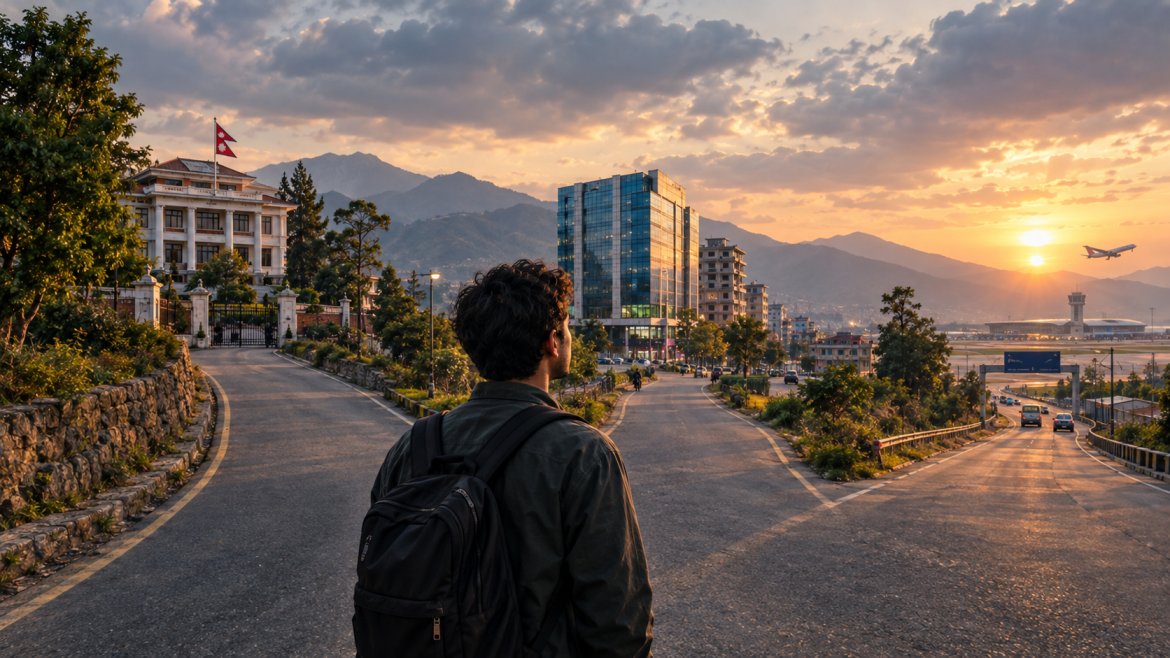
Government Job vs Private Job vs Abroad: 10 Questions Every Nepali Youth Must Answer First
Government Job vs Private Job vs Abroad: 10 Questions Every Nepali Youth Must Answer First
(Sarkari Jagir vs Private Jagir vs Bidesh — The Same Question, In the Words Everyone Actually Uses)
Every batch of +2 results does the same thing to a friend group. So does every batch of final bachelor’s results a few years later. It scatters everyone into the same old question — government job vs private job vs abroad Nepal, and nobody actually explains how to think about it.
One friend disappears into a library for Lok Sewa preparation and stops replying to group chats before 6 pm. Another joins a bank as a junior assistant and starts talking about targets like they’ve been doing it for years.
A third is doing IELTS classes in the evening, phone full of screenshots from visa consultancies. And one has already left — Australia, Japan, Korea, the Gulf — and posts photos that look calm and a little tired at the same time.
At home, somebody asks it in that same familiar tone. “Ab ke garne? Sarkari jagir ko taiyari garne, ki private ma jane, ki bidesh nai hane?”
Nobody says it like a demand. It comes wrapped in concern. It still lands the same way — pressure to have an answer you don’t have yet.
Everyone around you has an opinion. A cousin who did well in a bank. A neighbour who regrets going abroad. An uncle who insists Lok Sewa is the only real security left in this country.
In most households, this entire, complicated decision still gets squeezed into three words — sarkari jagir, private jagir, bidesh — as if each one meant just one simple thing. Sarkari, private, bidesh. Three words, and somehow your whole future is supposed to fit inside them.
What’s missing isn’t opinions. It’s a way to actually think this through.
It also isn’t a small question, even outside your own house. Frustration over jobs and opportunity has become visible enough in Nepal in recent years to spill onto the streets more than once. That’s not a headline to alarm you with — it’s context.
A large number of educated young people genuinely don’t see enough good options in front of them, and they’re trying to build a life anyway. You’re not confused because something is wrong with you. You’re confused because the actual situation is confusing.
So this article won’t tell you which path is better. It won’t rank government job, private job, or foreign employment, because none of them is automatically right or wrong. What it will do is walk through what each one actually asks of you, and what it actually gives back — the parts that get skipped over at the dinner table.
And if a parent is reading this instead of, or alongside, their son or daughter — you’re not intruding. Your worry is the other half of this exact story, and there’s a part further down written straight to you.
Sarkari Jagir: What the Exam Doesn’t Tell You
The government job comes through a structured process — mainly the Public Service Commission exams, across different services and levels. If you’re wondering which specific posts are even open to you right after +2, this guide to government jobs after +2 in Nepal walks through the actual entry routes. That structure is exactly why it’s seen as stable: the entry route is fixed, the rules are written down, and once you’re in, you can’t be removed on a whim.
That same structure is also why getting in is brutal. In one fiscal year covered in the PSC’s own annual report, close to 570,000 applications came in for under 6,000 announced vacancies. The post of Kharidar alone drew over 140,000 applicants for a fraction of that number of seats.
When a batch of local-level vacancies was later frozen over a reservation dispute, aspiring candidates who called themselves “PSC victims” demonstrated in Kathmandu. They said the delay had put years of their preparation, and their future, on hold. That’s the real shape of this exam — not the version people casually mention over tea.
Preparation can take one attempt or several years. Some candidates tutor or work part-time through it. Others prepare full-time, held up by family. If you’re at that preparation stage, it’s worth knowing that genuine PSC old question papers are now available through the official PSC question bank, rather than relying only on coaching-centre photocopies.
Neither is wrong, but both carry a cost that rarely gets said out loud: the years spent, the income not earned, the life on pause while a result comes.
Get in, and it usually means structured progression through defined levels, transfers that might land you in a different district than the one you grew up in. There’s daily work that means something too — issuing documents, enforcing rules, dealing with people who walk in already frustrated.
There’s real meaning in doing that honestly. There’s also real friction in slow processes and limited resources that don’t match what people expect from you — and that gap between the promise of a government post and its day-to-day reality is worth reading about in more depth in the hidden expiration date of a permanent sarkari jagir.
Here’s a distinction worth sitting with, because it rarely gets said plainly: wanting to serve the public and wanting a secure job are not the same motivation, even though everyone treats them as one thing. You can genuinely want administration and public responsibility, or you can simply want the stability a government post is known for.
Both are fair reasons. But knowing which one is actually pulling you changes how you’ll feel about the job ten years from now — not just whether you clear the exam.
Private Jagir: One Word, Many Different Lives
It’s the phrase people actually use, and it hides more variety than the term suggests. It could mean banking, IT, teaching, consulting, a corporate role, a startup, an NGO, hospitality, media, sales, accounting, marketing, or building something of your own.
What most of these share is a faster start. You can usually begin earning before someone still preparing for a government exam does. Growth tends to track performance more directly — a good year, a skill picked up, a project done well can move you faster than seniority alone would.
There’s more mobility too. Moving between companies, even industries, is normal and often necessary.
The trade-off is less predictability. Job security swings wildly by sector and company, and the pressure is more constant than in government service. Some private roles pay very well; plenty don’t, especially at the start.
There’s no honest way to say private jobs always pay more than government ones, or the reverse. Anyone claiming that with confidence is generalizing from one example, usually their own. For a more personal, day-to-day account of how this specific comparison actually feels from inside a government office, this piece looks at government vs private job in Nepal from that angle.
Bidesh: The Option Everyone Talks About, Few Fully Plan
It’s the word every household reaches for, and it isn’t one option — it’s a whole category wearing one name. Foreign labour employment, study-to-work routes, skilled migration, short-term contracts, long-term settlement. Each has its own shape, cost, and risk.
The scale of it in Nepal is hard to overstate. Nepal Rastra Bank’s own data for fiscal year 2024/25 shows 505,957 Nepali workers received first-time approval for foreign employment, with another 333,309 approved for renewed entry — and the pace hasn’t slowed. In just the first six months of the current fiscal year, 206,807 workers took first-time approval and remittance inflows alone crossed Rs 1.063 trillion.
Neither is simple, though. “I want to go abroad” isn’t a plan by itself — it becomes one only once you know the actual details.
Which country. Through which route. Under which employer or institution. At what total cost, recruitment fees included. What the real salary and living expenses look like once you’re there. What the contract actually says. What your legal status will be. And the question everyone avoids — what happens if you want, or need, to come back.
The risks are documented, not imagined: recruitment debt some workers carry for years, promises from agents that don’t match the job on arrival, harsh conditions in certain sectors and countries, visa restrictions. Distance from family that doesn’t get lighter just because the salary is better, and the pressure of sending money home while trying to save anything at all.
None of this is a reason to avoid it. It’s a reason to ask specific questions before signing anything.
Studying Abroad Is Its Own Decision, Not Just Another Kind of Bidesh
There’s a separate conversation happening under the same word “bidesh,” and it deserves its own space: education.
Foreign study has grown into a serious financial commitment for Nepali families, not just a scholarship story for the lucky few. A useful degree abroad can open doors no exam or job offer in Nepal can. It can also mean years of loan repayment for a qualification that turns out to have less value than the consultancy brochure promised.
Before “study abroad” becomes a plan, it needs the same honesty as any other big decision. What will the degree actually cost, once living expenses are added to tuition? How much of that is borrowed? What work are you legally allowed to do while studying, and how much can that realistically cover? What happens in the months right after graduation, when the student visa’s grace period is running out and a job hasn’t shown up yet? And if you do come back to Nepal, what will this specific degree be worth here?
A foreign university’s name on your CV can be genuinely valuable. On its own, it is not a career strategy.
Money Matters, But It’s Not the Whole Story
Money is real, and pretending otherwise helps no one. But reducing this whole decision to one number — starting salary — misses most of what actually shapes your financial life five years out.
What matters more is how income grows over time, not just where it starts. What benefits come attached. How stable that income actually is. What it costs to live wherever the job is, and whether there’s debt tied to getting there.
Someone earning more abroad, after recruitment debt and cost of living, can end up with less in hand than someone earning modestly in Nepal with no debt and low expenses. Someone in a government post on a lower salary but total job security sits in a very different place than someone in a similarly paid private job with no certainty about next year.
None of these comparisons mean anything if you only look at the headline number.
The Cost Nobody Puts on the Table: Time
Money isn’t the only thing quietly spent while you decide. Time is too, and almost nobody puts a number on it.
Two years preparing for Lok Sewa is two years. A year and a half arranging documents and waiting on a visa is a year and a half. A private job for that same stretch is time too — just spent differently.
The real question isn’t which path takes the least time. It’s what you’re becoming while the clock runs.
Someone preparing for two years while also improving their English, learning to write clearly, picking up basic accounting or digital skills, ends up somewhere very different from someone who spent those same two years only doing rounds at a coaching centre. Someone waiting a year for a visa while also learning the destination country’s language is ahead of someone who just waited.
None of this is a push to abandon Lok Sewa, rush a foreign employment plan, or quit a private job early. It’s a reminder that a career plan should never become an excuse to stop growing — and it’s exactly what quietly separated two colleagues in the same government job years after they both started.
The Weight of Family and Social Pressure
None of this gets decided in a quiet room, either. There’s almost always a voice, or several, in the background.
“Government job nai secure ho.” “Private job ma future chaina.” “Sabai sathi bidesh gaisake.” “Timro age ma ta job hunuparcha.” “Lok Sewa try gara.” “Abroad gayera ramro kamaunchhau.” Anyone who has been through this in Nepal has heard some version of all six.
Most of the time, these aren’t said to control you. Parents and relatives speak from what security and struggle looked like in their own years.
A father who lived through real uncertainty will push toward stability. A mother who watched a neighbour’s household transform through remittance will see abroad as opportunity. It comes from fear and from care, even when it doesn’t fit your situation exactly.
The tension isn’t really between you and them. It’s between the life other people can imagine for you, based on what they’ve seen work before, and the life you’re actually trying to build, based on who you are now.
Both things can be true — that your family genuinely wants good for you, and that their picture of “good” was shaped by a different Nepal than the one you’re standing in.
A Note for Parents and Elders
If you’re reading this because you lie awake some nights wondering what will become of your child — you’re not alone in that, and you’re not wrong to care this much. Watching someone you raised stand at a crossroads you can’t walk for them is its own kind of hard.
Most of what you feel comes from experience, not a wish to control. You remember what insecurity actually cost, or what a stable government post meant for a family in harder years. That memory is real — it just isn’t automatically your child’s memory, because they aren’t living the years you lived through.
A child who wants time to think isn’t lazy or ungrateful. Two years of honest, focused Lok Sewa preparation looks nothing like two years of drifting, and it’s usually easy to tell the two apart if you watch closely instead of watching the calendar.
Fear and love can sound identical but pull in different directions. “I want you to be safe” and “I’m afraid of what people will say if you’re not settled by a certain age” often come out in the same breath, and they aren’t the same thing.
The most useful thing you can offer, most of the time, isn’t a decision. It’s questions asked without a verdict already attached — what does the job actually pay, what will the first two years look like, what’s the backup plan.
The table and the questions further down work as well done together as they do alone. And if your child picks a path you wouldn’t have picked for them, it doesn’t mean they’ve chosen wrong.
Talented, Average, or Somewhere in Between — This Still Applies to You
If you were always near the top of your class, this decision comes with an extra weight nobody talks about. You probably have more real options than most of your friends, and more people expecting you to pick the “impressive” one.
A merit scholarship abroad, a top rank in Lok Sewa, a fast-track corporate job — any of these might genuinely be within reach for you. The trap for a strong student isn’t picking wrong. It’s picking based on which option sounds most impressive at a family gathering, instead of which one actually fits the life you want to live.
If you’ve never topped anything, but you’ve shown up and done the work year after year, don’t undersell what that actually is. Consistency is rarer than talent, and it compounds in ways a single brilliant result never does.
A Lok Sewa aspirant who studies steadily without dramatic breakthroughs, a private-sector employee who quietly gets a little better every year, a migrant worker who sends money home reliably — these are not lesser stories next to the topper’s story. They’re just less visible ones, right up until the point where they aren’t.
And if you’re somewhere in the middle — decent results, no scholarships, no dramatic talent, just an ordinary student trying to figure out the next step — almost everything in this article was written with you specifically in mind. You’re the one least likely to have someone sit you down and walk through it properly.
A Comparison, Without a Winner
| Factor | Government Job | Private Job | Abroad |
|---|---|---|---|
| Entry process | Competitive PSC exam, one attempt or several years | Applications, interviews, sometimes internships first | Recruitment agency, direct hiring, or study/visa process |
| Time to start earning | Delayed until exam is cleared | Usually the fastest of the three | Delayed by documentation, visa processing, recruitment cost |
| Income growth | Structured, tied to service levels and seniority | Tied to performance, industry and company | Depends heavily on country, sector, contract renewal |
| Job stability | High, once appointed | Varies significantly by sector and company | Depends on contract terms and country’s labour laws |
| Skill development | Administrative, procedural, policy-related | Varies widely, often technical or industry-specific | Practical and hands-on, sometimes narrow to one role |
| Career mobility | Limited outside government structure | Relatively high, across companies and industries | Limited unless you deliberately build transferable skills |
| Family proximity | Usually maintained, with possible transfers | Usually maintained | Usually reduced, sometimes for years |
| Financial risk | Low, apart from the opportunity cost of preparation | Moderate, depends on the sector’s stability | Can be high, from recruitment debt and living costs |
| Lifestyle | Structured routine, public accountability | Faster-paced, often variable hours | Depends entirely on destination and job type |
| Major challenge | Getting in, and the years that takes | Constant performance pressure, less predictability | Managing distance, debt, and a new system |
Each row is a real trade-off, not a point scored for anyone. A table can show you the shape of the decision. It can’t make it for you.
Before Choosing, Ask Yourself These Questions
What kind of life do I actually want, day to day? Not the one that photographs well. The one you’ll actually be living.
Do I need to start earning soon? And is that need financial, or just impatience?
How much time can I realistically commit to preparation, whichever path I choose? Be honest here, not hopeful.
What skills do I already have that someone would pay for?
What could I build in the next twelve months, no matter which door I walk through?
How much financial risk can my family absorb if this doesn’t go as planned? Especially important with recruitment debt on the table.
Am I choosing this because I want it, or because everyone around me expects it? Both can lead to the same decision. Only one of them survives year three.
What kind of daily work would I actually enjoy, separate from the title attached to it?
What’s my backup plan?
If my first plan fails, what would I do next — and how fast could I move on it?
A Simple Way to Think It Through
If ten questions feel like too much to hold in your head, five words cover most of the same ground.
Skills — what can you already do, and what are you willing to learn next?
Money — what does your actual financial situation allow, not the ideal version of it?
Time — how long can you wait before you need income?
Risk — how much uncertainty can you genuinely carry without it wearing you down?
Life — what do you want your days to look like outside of work, and how close to home?
None of these has a universal right answer. Sitting with them honestly is worth more than any ranking could be.
Comparing Yourself to Everyone Else’s Timeline
One more thing shapes this decision more than people admit, and it isn’t money or family. It’s comparison.
A friend goes abroad and starts sending money home. Someone from your batch clears Lok Sewa on the first try. Someone joins a bank straight out of college. Someone is still studying, quietly, while everyone else seems to be moving.
None of it means you’re behind. Your friend’s timeline was never your deadline — people are working with completely different resources, family situations, and starting points, even the ones who graduated the same year you did.
You don’t need your whole life figured out at twenty, or twenty-five. You need to be learning something useful wherever you currently stand, so your next decision is a slightly better one than this one.
A Thought From the Other Side of a Government Desk
Nearly nine years inside Nepal’s civil service has shown me something that doesn’t come across from the outside — a job title tells you very little about a person.
I’ve seen colleagues with respected posts who are quietly struggling, and people in private companies who built more skill and confidence than their designation would suggest. I’ve watched people leave for foreign employment and come back with money and clarity about what they wanted next, and I’ve watched others come back with only exhaustion and debt. I’ve also watched people stay in Nepal, in ordinary jobs, and build genuinely solid lives.
None of these paths guaranteed the outcome. What made the difference, almost every time, was what the person chose to build along the way, and how honestly they’d thought about the choice before making it.
A career isn’t only where you work. It’s what you learn while you’re there, what you give up to get there, and who the work slowly turns you into.
Where This Leaves You
A government job isn’t automatically success. A private job isn’t automatically a lesser path. Going abroad isn’t automatically the smart move, and staying in Nepal isn’t automatically settling for less.
What matters is understanding the road — the real preparation it demands, the real price it carries, the real risk sitting underneath the opportunity. And quietly, who you’re likely to become while walking it.
Before you close this tab, do one small thing. Pick whichever of the ten questions above made you pause the longest, and write an honest answer to just that one — two or three sentences, somewhere you’ll see it again tomorrow.
Reading about a decision changes how you think about it. Answering even one question honestly is what starts to change what you do.
If someone you know is standing at this exact crossroads right now — an exam form in one hand, a job offer in the other, a visa consultancy appointment on their phone — this is worth sending to them. And if you’re the parent carrying the same crossroads at night, it might be worth reading with your child instead of talking at each other about it.
The remittance and foreign employment figures cited here come from Nepal Rastra Bank’s own macroeconomic reporting, which is worth checking directly for the latest available numbers.





2 Comments