Property Rights of NRN Citizens in Nepal: What Can NRNs Legally Buy, Own and Inherit?
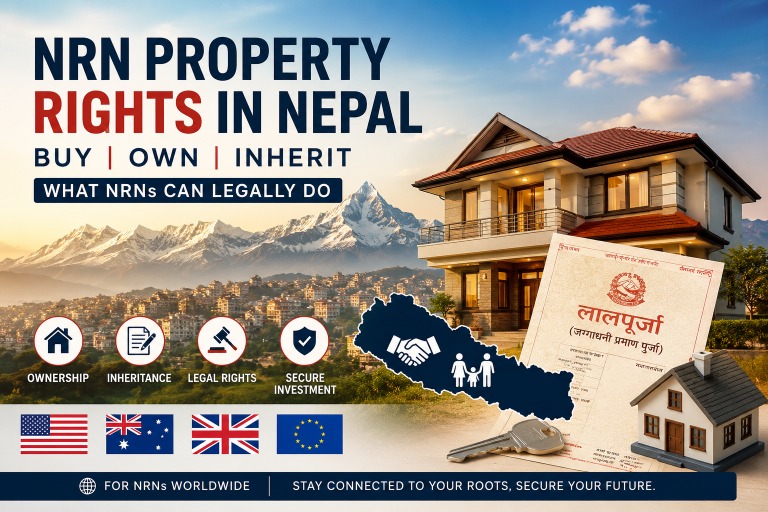
NRN Property Rights in Nepal can be confusing, especially for Nepalis living in the USA, Australia, the UK and other countries. For many people, property in Nepal is more than just an investment—it may be a family home, ancestral land or a connection to the place they still call home.For many Nepalis living abroad, property in Nepal is more than just an investment.
It may be the family home. A piece of ancestral land. Property left by parents. Or simply a plan to return home one day and build a house.
But when the time comes to buy, inherit or transfer that property, a common question appears:
Can an NRN legally own property in Nepal?
The answer is not as simple as a yes or no.
A Nepali citizen working in Australia, the UK or the United States may casually describe themselves as an NRN. So might someone who was once a Nepali citizen but later acquired foreign citizenship. Yet, under Nepali law, those two people may not always stand in the same legal position.
That difference can become important when you want to buy land, inherit your parents’ property, divide family property or sell something you already own in Nepal.
So, before asking “Can an NRN buy land in Nepal?”, it helps to ask a more basic question first:
What is your legal status today?
1. Who Is Legally Considered an NRN?
In everyday conversation, the word NRN is often used for any Nepali living abroad. Legally, however, the term has a more specific meaning.
Nepal’s Non-Resident Nepali Act, 2064 broadly recognises two groups within the concept of a Non-Resident Nepali:
- Nepali citizens living abroad who meet the conditions set by law; and
- foreign citizens of Nepali origin.
A foreign citizen of Nepali origin generally refers to a person who, or whose parents or grandparents, had a Nepali connection but who has since acquired foreign citizenship outside the SAARC region.
This distinction may sound technical, but it matters.
Imagine two people living in the United States:
- Person A still holds Nepali citizenship and is living abroad for work or business.
- Person B was once a Nepali citizen but later became a US citizen.
Both may identify themselves as NRNs. But when it comes to acquiring or inheriting immovable property in Nepal, their legal position may be different.
There is also another important category: a person who has obtained Non-Resident Nepali citizenship under Nepal’s constitutional and citizenship framework.
In other words, NRN citizenship and NRN status are not the same thing.
2. Nepali Citizen Living Abroad vs Foreign Citizen of Nepali Origin
Before looking at land or inheritance rights, it is useful to separate the main categories.
| Category | Citizenship status | General property position |
|---|---|---|
| Nepali citizen living abroad | Still a Nepali citizen | Generally remains subject to the property and land laws applicable to Nepali citizens |
| Foreign citizen of Nepali origin | Has acquired foreign citizenship | May access specific property rights and facilities available under NRN law, subject to conditions |
| Person holding NRN citizenship | Holds constitutionally recognised NRN citizenship | Has a special legal position in certain matters involving inherited or partitioned property |
| Ordinary foreign national | Foreign citizen without Nepali-origin status | Subject to the general legal restrictions applicable to foreigners acquiring immovable property |
This is the point where much of the confusion begins.
Someone may say, “NRNs can buy land in Nepal.”
That statement is too broad on its own.
The better question is:
Which type of NRN are we talking about, and how is the property being acquired?
Buying property, inheriting property and receiving property through family partition can involve different legal rules.
3. Can NRNs Buy Land in Nepal?
If you are still a Nepali citizen
Living abroad does not automatically make you a foreigner.
If you remain a Nepali citizen, your residence in another country does not, by itself, take away the property rights available to Nepali citizens. Your property transaction will generally be assessed under the laws applicable to Nepali citizens.
For example, a Nepali citizen living and working in Japan is legally different from a person who has given up Nepali citizenship and acquired Japanese citizenship.
That difference should be understood before entering into a property transaction.
If you are a foreign citizen of Nepali origin
The Non-Resident Nepali Act, 2064 provides a specific framework allowing a foreign citizen of Nepali origin to acquire land or other immovable property in Nepal for residential purposes, subject to the conditions set by law.
The law is designed to allow eligible persons to maintain a residential connection with Nepal. It does not simply mean that a foreign citizen of Nepali origin can purchase unlimited land anywhere in the country.
The Non-Resident Nepali Rules, 2066 prescribe location-based limits for property acquired for residential purposes.
Land limits under the NRN Rules
| Location | Maximum area |
|---|---|
| Kathmandu Valley | 2 ropani |
| Municipal area of a Terai district | 8 kattha |
| Municipal area of other districts | 4 ropani |
| Specified areas outside municipalities in the Terai | 1 bigha |
| Other areas | 10 ropani |
The Rules also establish an approval process before the transaction is completed.
In practical terms, this means that an eligible foreign citizen of Nepali origin should not simply find a property, pay the seller and assume that registration will automatically take place.
The buyer’s legal eligibility and the applicable approval process should be checked before signing the final agreement or transferring a significant amount of money.
4. What About Property Already Owned Before Acquiring Foreign Citizenship
This is another area where people often become confused.
Suppose someone bought land in Nepal while they were a Nepali citizen.
Years later, they move abroad and acquire foreign citizenship. This is where understanding NRN citizenship in Nepal becomes particularly important, because citizenship status and NRN status can affect how a person’s legal position is understood.
Does that mean the property automatically disappears from their ownership?
The situation should not be reduced to such a simple conclusion.
The person’s citizenship status has changed, and that can affect future transactions and the legal treatment of the property. However, questions involving existing property, future inheritance, family partition and new purchases may need to be examined separately.
The important point is this:
Acquiring foreign citizenship can change your legal position, but the consequences may depend on how the property was acquired and what legal status you currently hold.
For this reason, anyone who has acquired foreign citizenship should review their property position before:
- purchasing additional land;
- registering inherited property;
- entering into family partition;
- transferring property to another person; or
- restructuring ownership.
5. Can an NRN Inherit Property in Nepal?
For many families, this is more important than buying new land.
A person may not be interested in purchasing property at all. Instead, their concern may be:
“My parents own land in Nepal. Can I inherit it even though I now live abroad or hold foreign citizenship?”
Again, the answer depends heavily on legal status.
The Muluki Civil Code, 2074 contains provisions dealing with foreigners receiving immovable property through inheritance or partition.
As a general principle, the law places restrictions on foreigners receiving immovable property in Nepal. However, the Code also recognises a specific exception for persons who hold Non-Resident Nepali citizenship.
This distinction is extremely important.
It means that simply being a person of Nepali origin living abroad does not automatically answer the inheritance question.
The following issues may need to be considered:
- Are you still a Nepali citizen?
- Have you acquired foreign citizenship?
- Do you hold NRN citizenship?
- Is the property being inherited or received through family partition?
- Has the property already been legally transferred or registered?
- Are there other heirs or ownership disputes?
For inherited or ancestral property, the safest approach is to verify the person’s current legal status before starting the formal transfer process.
6. Ancestral Property and Family Property Are Not Always Simple
Property disputes within families often become more complicated when one or more family members live abroad.
A person may assume:
“It is my family’s land, so I automatically have the right to register it in my name.”
But family connection alone does not remove the legal requirements surrounding inheritance, partition or registration.
The nature of the property matters.
For example, the legal process may differ depending on whether the property is:
- ancestral property;
- property inherited from parents;
- jointly owned family property;
- self-acquired property;
- property being divided through family partition; or
- property transferred through a gift or another legal arrangement.
When citizenship status is added to the situation, the transaction can become even more complicated.
That is why it is often better to resolve questions about citizenship and eligibility before the family completes a partition agreement, rather than discovering a registration problem afterwards.
7. What Happens When a Nepali Citizen Acquires Foreign Citizenship?
Nepal does not generally recognise unrestricted dual citizenship.
Under the citizenship law, voluntarily acquiring foreign citizenship affects a person’s Nepali citizenship status.
This is important because property rights in Nepal are closely connected to the distinction between a Nepali citizen and a foreign citizen.
However, the practical consequences are not always identical in every situation.
There is an important difference between:
- property already owned while the person was a Nepali citizen;
- property inherited after acquiring foreign citizenship;
- property received through family partition; and
- new property the person wants to purchase after becoming a foreign citizen.
A person who has acquired foreign citizenship may also have access to the separate legal framework relating to Non-Resident Nepali citizenship, provided the relevant legal requirements are met.
For this reason, someone who has changed citizenship should avoid relying on old assumptions about their property rights.
A rule that applied while you were a Nepali citizen may not automatically apply in exactly the same way after your citizenship status changes.
8. Can NRNs Sell or Transfer Property?
Generally, a person who lawfully owns property may have the right to sell or transfer it, subject to Nepal’s property, land, registration and other applicable laws.
But once again, the details matter.
A transaction may involve:
- selling property;
- transferring property to family members;
- gifting property;
- dividing property through partition;
- transferring inherited property; or
- exchanging one property for another.
The buyer or recipient’s legal status can be just as important as the seller’s.
For example, a Nepali citizen may not simply transfer immovable property to a foreign citizen without considering the legal restrictions and approval requirements that apply to foreigners.
Similarly, a foreign citizen of Nepali origin who has acquired property under the NRN legal framework should check the applicable law before selling or transferring it.
The safest rule is simple:
Before transferring property, check not only whether you own it, but whether the proposed recipient is legally eligible to receive it.
9. Can an NRN Buy Property Through Power of Attorney?
For people living overseas, travelling to Nepal for every stage of a property transaction may not be practical.
This is why many NRNs consider using a power of attorney.
A properly authorised representative may be able to act on behalf of the property owner or buyer where the law and registration procedures allow it.
But a power of attorney has limits.
It allows another person to represent you. It does not give you property rights that you would not otherwise have.
In simple terms:
A power of attorney can help you complete a legal transaction from abroad. It cannot turn an illegal transaction into a legal one.
Before relying on a representative, verify:
- who the representative is;
- what authority has actually been granted;
- whether the document specifically covers the intended transaction;
- whether it has been properly authenticated;
- whether it remains valid;
- whether the authority has been revoked; and
- whether the actual buyer or owner is legally eligible to acquire the property.
This is particularly important when the power of attorney is executed outside Nepal.
10. What Documents and Checks Are Usually Important?
The exact requirements depend on the property, the location and the type of transaction.
However, before proceeding, buyers and heirs should generally expect to verify matters such as:
- citizenship or legally recognised identification;
- passport and immigration-related documents, where relevant;
- NRN identity or NRN citizenship documents, where applicable;
- land ownership certificates and previous transfer documents;
- tax or revenue records;
- inheritance or family partition documents;
- the authority of any representative acting under power of attorney; and
- government approval where required.
But paperwork alone is not enough.
A property may have apparently valid documents and still be affected by a dispute, mortgage, ownership claim or other restriction.
Before paying a large advance, it is wise to ask two separate questions:
Is the seller legally entitled to sell this property?
And:
Am I legally entitled to register this property in my own name?
Both questions matter.
11. Tax and Financial Issues to Consider
The price of the property is not always the final cost.
Depending on the transaction, there may also be:
- registration fees;
- applicable taxes;
- tax obligations arising from a future sale;
- banking documentation;
- source-of-funds requirements; and
- foreign-exchange considerations.
These requirements can change over time through finance laws, tax rules and government procedures.
For NRNs bringing money into Nepal from abroad, it is particularly important to use legally compliant banking channels and maintain clear records of the source and movement of funds.
The tax consequences of a property transaction can vary depending on the nature of the property and the transaction. Professional advice may therefore be appropriate before completing a major purchase or sale.
12. Common Myths About NRN Property Rights
Myth: Every Nepali living abroad is treated as a foreigner.
Reality: No. Someone who remains a Nepali citizen has a different legal position from someone who has acquired foreign citizenship.
Myth: Every NRN has the same property rights.
Reality: The term NRN covers different legal categories. Citizenship status can make a significant difference.
Myth: An NRN can buy unlimited land in Nepal.
Reality: Specific limits apply under the NRN legal framework for foreign citizens of Nepali origin acquiring immovable property for residential purposes.
Myth: A foreign citizen of Nepali origin can automatically keep any inherited land forever.
Reality: Inheritance involving immovable property must be examined according to the person’s legal status and the applicable provisions of the Civil Code.
Myth: Buying property in a relative’s name is an easy solution.
Reality: This can create serious problems later. The person whose name appears in the official records may have legal rights that do not match the informal understanding within the family.
Myth: A power of attorney can bypass citizenship or property restrictions.
Reality: A representative can act on your behalf, but cannot give you a right that you do not legally have.
13. What NRNs Should Check Before Buying or Claiming Property
Before moving forward, take a moment to work through this checklist:
- Confirm your current citizenship status.
- Determine whether you are still a Nepali citizen, a foreign citizen of Nepali origin or a holder of NRN citizenship.
- Identify whether the property is being purchased, inherited or received through family partition.
- Check whether any location or area limits apply.
- Confirm whether government approval is required.
- Verify the seller’s ownership and transaction history.
- Check for disputes, mortgages or other restrictions.
- Verify land classification and any limitations on transfer or use.
- Understand registration fees and tax obligations.
- Carefully verify any power of attorney.
- Keep clear records of the source of funds.
- Obtain independent legal advice before committing to a major transaction.
Frequently Asked Questions
Can an NRN buy land in Nepal?
Yes, but the answer depends on what type of NRN you are. A Nepali citizen living abroad generally has a different legal position from a foreign citizen of Nepali origin. Foreign citizens of Nepali origin may acquire limited immovable property for residential purposes under the NRN legal framework.
How much land can an NRN own in Nepal?
For foreign citizens of Nepali origin purchasing property for residential purposes under the NRN Rules, the permitted area varies by location. For example, the Rules prescribe a limit of up to 2 ropani in Kathmandu Valley and different limits for municipal and other areas.
These limits should not automatically be treated as the property limit for every Nepali citizen living abroad.
Can a Nepali citizen living in the USA buy land in Nepal?
If the person remains a Nepali citizen, simply living in the USA does not automatically make that person a foreign citizen for property purposes.
However, if the person has acquired US citizenship, the legal position changes and should be examined according to the person’s current citizenship and NRN status.
Can a foreign citizen of Nepali origin inherit property in Nepal?
The answer depends on the person’s exact legal status. Nepal’s Civil Code places restrictions on foreigners receiving immovable property through inheritance or partition while recognising a specific position for persons holding Non-Resident Nepali citizenship.
What happens to property after acquiring foreign citizenship?
Acquiring foreign citizenship can change a person’s legal position under Nepal’s citizenship and property laws. Existing property, newly purchased property and inherited property may raise different legal questions.
Anyone who has acquired foreign citizenship should review their property status before entering into a new transaction.
Can an NRN sell inherited property?
Possibly, but the answer depends on whether the property was lawfully acquired, registered and held under the applicable legal framework. The individual’s citizenship status and the nature of the inheritance can also matter.
Can an NRN buy a house or apartment in Nepal?
An eligible foreign citizen of Nepali origin may acquire immovable property for residential purposes within the legal framework established by the NRN Act and Rules. The legal structure of the particular property should still be checked before purchase.
Can an NRN use a power of attorney to buy property?
A representative may be able to act under a properly executed and legally recognised power of attorney. However, using a representative does not remove the legal requirements that apply to the actual buyer.
Can a foreign citizen receive land as a gift from a Nepali citizen?
Transfers of immovable property to foreigners are subject to legal restrictions and may require government approval unless a specific legal exception applies.
Is NRN status the same as NRN citizenship?
No. NRN status under the Non-Resident Nepali Act and Non-Resident Nepali citizenship under Nepal’s constitutional and citizenship framework are different legal concepts. That distinction can be important, particularly in matters involving inheritance and family partition.
The Bottom Line
For NRNs and Nepalis living abroad, the question is not simply:
“Can I own property in Nepal?”
A better question is:
“Given my current citizenship status, how am I acquiring the property, and what rules apply to me?”
A Nepali citizen living overseas may have a different position from a former Nepali citizen who has acquired foreign citizenship. A foreign citizen of Nepali origin may be able to acquire limited residential property under the NRN legal framework. And a person holding Non-Resident Nepali citizenship may have a separate legal position when property is received through inheritance or family partition.
That is why it is worth checking the legal position before signing an agreement, sending money or completing a family property division.
A small misunderstanding about citizenship or ownership rules can become a much bigger problem once money has been paid and the registration process has already started.
Legal Disclaimer: This article is intended for general informational purposes only and should not be treated as legal advice. Property, citizenship, inheritance and land laws may change, and the legal outcome can depend on individual circumstances. Readers should verify the current law and consult a qualified legal professional or relevant government authority before entering into a property transaction.
Official Legal Sources and Further Reading
For the current legal position, readers should consult the latest versions of:
- The Constitution of Nepal — including provisions relating to Non-Resident Nepali citizenship.
- Non-Resident Nepali Act, 2064 — including provisions relating to the definition of NRNs and acquisition of immovable property.
- Non-Resident Nepali Rules, 2066 — including location-based limits and procedures for residential property acquisition.
- Muluki Civil Code, 2074 — including provisions dealing with ownership, transfer, inheritance and immovable property involving foreigners.
- Nepal Citizenship Act, 2063 — including provisions concerning the effect of acquiring foreign citizenship.
- Land Act, 2021 and other applicable land and registration laws.
- Official publications and current procedures of the Nepal Law Commission, Department of Land Management and Archive, and other relevant Government of Nepal authorities.
Because property and citizenship laws can be amended and administrative procedures may change, the applicable law and government requirements should always be verified at the time of the transaction.