
How to Write High-Scoring Answers in Loksewa and Public Sector Exams
Think Like an Officer. Write Like One.
Looking for practical Loksewa answer writing tips? You’re in the right place.
Preparing for a competitive examination is more than completing the syllabus. It is about proving, on the day of the exam, that you can organize your thoughts, communicate clearly, and respond with sound judgment.
Whether you’re preparing for the Civil Service, Banking, Teacher Service Commission, Nepal Army, Nepal Police, APF, Judicial Service, or Foreign Service, the way you write your answers can have a direct impact on your final score.
Why?
In most cases, it isn’t because they lacked knowledge. It’s because they couldn’t present that knowledge in a way that earned marks.
The examiner doesn’t know how many hours you studied or how many books you completed. The only thing they evaluate is what appears on your answer sheet. A well-written answer demonstrates clarity, relevance, analytical thinking, and the qualities expected from a future public servant.
The encouraging part is that answer writing isn’t a gift reserved for a few people. It is a skill that improves with practice, reflection, and consistency.
Whether you’re preparing for the Civil Service, Banking, Teacher Service Commission, Nepal Army, Nepal Police, APF, Judicial Service, Foreign Service, or any other public sector examination, strengthening your answer writing can significantly improve your overall performance.
The ideas shared in this article come from practical preparation and experience. If you’re curious about the preparation strategy that helped me clear the examination in my first attempt, you can read the complete guide here: How I Cleared Loksewa in My First Attempt.
Understand the Role You’re Preparing For
Loksewa Answer Writing Tips That Actually Make a Difference – One answer doesn’t fit every service.
The examiner expects your response to reflect the responsibilities of the position you’re applying for.
If you’re preparing for the Civil Service or Local Level, your answers should naturally discuss public service delivery, good governance, accountability, transparency, policy implementation, and citizen-centered administration.
For the Judicial Service, strong answers are supported by constitutional provisions, relevant laws, legal principles, and judicial interpretation.
In the Foreign Service, your perspective should include diplomacy, Nepal’s foreign policy, international cooperation, and national interests.
If your goal is the Banking Sector, focus on monetary policy, financial stability, banking regulations, digital banking, risk management, and current economic developments.
Candidates preparing for the Teacher Service Commission (TSC) should demonstrate an understanding of learner-centered teaching, classroom management, assessment methods, and educational reforms.
For Nepal Army, Nepal Police, APF, and Investigation Services, answers should reflect leadership, discipline, crisis management, professionalism, national security, and respect for human rights.
The facts may remain the same, but the perspective should match the service.
Keep Your Answer Simple and Structured
Examiners read hundreds of answer sheets within a limited time.
A well-structured answer makes their job easier—and that often works in your favour.
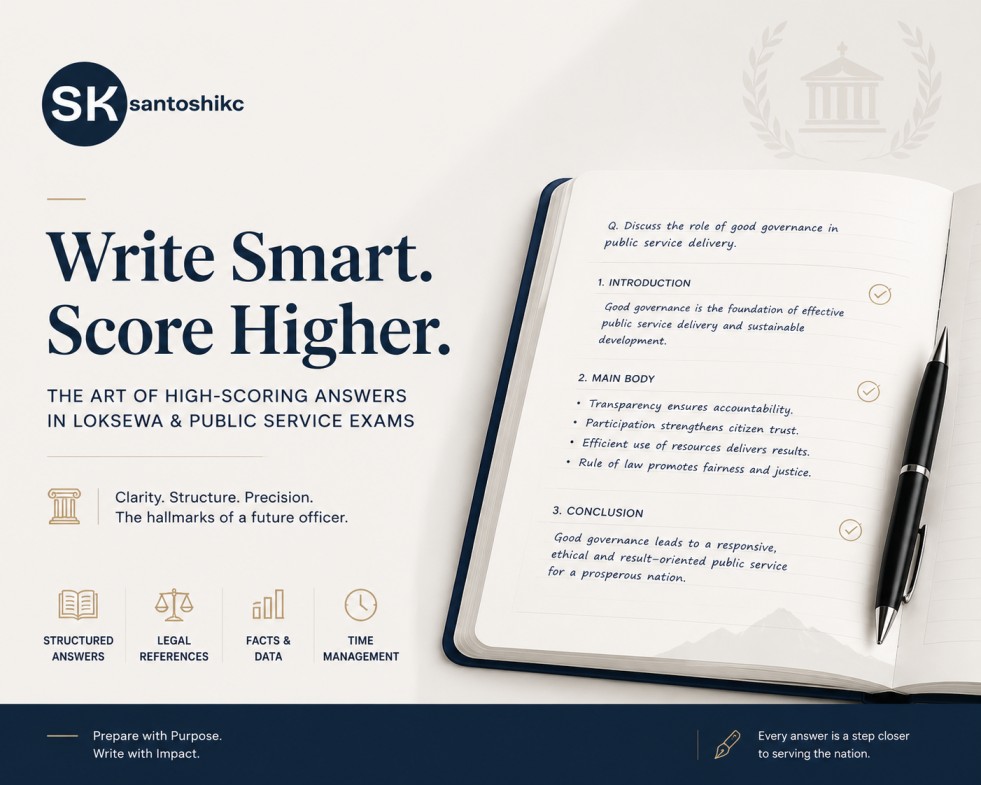
A simple three-part structure is enough. For example-
Introduction
Begin with a brief definition, concept, constitutional provision, or background. Two or three meaningful lines are usually sufficient.
Main Body
This is where most of your marks are earned.
Present your ideas logically. Use short paragraphs, bullet points, or subheadings whenever they improve readability. Where appropriate, strengthen your arguments with examples, official data, policies, or legal references.
Avoid writing one long paragraph that forces the examiner to search for your main points.
Conclusion
Finish with a balanced and practical conclusion.
Rather than repeating earlier points, briefly explain the way forward or the broader significance of the issue.
Support Your Arguments with Reliable References
Good answers are built on evidence, not assumptions.
Whenever the question allows, support your discussion with authentic sources such as:
- The Constitution of Nepal
- Relevant Acts and Regulations
- The Sixteenth Periodic Plan
- Annual Budget priorities
- Auditor General’s Reports
- Nepal Rastra Bank publications
- Official government reports and statistics
This doesn’t mean every answer needs statistics or legal provisions.
One relevant reference is often enough to strengthen your argument and demonstrate credibility.
Write with Time in Mind
Time management is one of the most underestimated parts of the written examination.
Some candidates spend too long perfecting one answer and then struggle to complete the rest of the paper.
As a practical guide:
| Marks | Words | Suggested Time |
|---|---|---|
| 5 Marks | 80–120 words | 7–8 minutes |
| 10 Marks | 180–250 words | 14–16 minutes |
Remember, every mark contributes to your final ranking.
A complete paper with consistently good answers almost always performs better than an incomplete paper with a few excellent ones.
Make Answer Writing Part of Your Daily Routine
Reading helps you understand a topic.
Writing teaches you how to explain that understanding within the time and space available in the examination hall.
The two are not the same.
A simple routine can help you improve steadily.
Choose two previous-year questions each day.
Set a timer.
Write your answers on plain paper.
Then read them again—not as a student, but as an examiner.
Ask yourself:
- Did I answer what was actually asked?
- Are my ideas arranged logically?
- Can the key points be identified quickly?
- Is my conclusion meaningful?
Small improvements made consistently are far more valuable than occasional bursts of preparation.
Common Mistakes That Reduce Marks
Many candidates lose marks because of presentation rather than content.
Some of the most common mistakes include:
- Writing lengthy introductions.
- Ignoring the actual demand of the question.
- Filling pages with long, unstructured paragraphs.
- Using unsupported personal opinions.
- Ending without a clear conclusion.
- Spending too much time on one question.
- Leaving questions unanswered.
Being aware of these mistakes is often the first step toward avoiding them.
Final Thoughts
Competitive examinations don’t reward the candidate who studies the longest. They reward the candidate who communicates their understanding clearly, logically, and within the time available.
That’s why answer writing deserves as much attention as reading and revision.
Don’t expect every practice answer to be perfect.
Instead, aim to make today’s answer slightly better than yesterday’s.
Over time, those small improvements become confidence.
And confidence built through practice is far more reliable than confidence built on hope.
When you sit in the examination hall, your answer sheet should reflect not only what you know, but also how you think.
That’s the quality every public institution looks for.
Study with purpose.
Write with clarity.
Let every answer reflect the officer you aspire to become.



One Comment